
PPG’s Loudon investment and automotive coating technologies
PPG’s Loudon plan links a new automotive-coatings plant with upgrades in Ohio and Mexico, alongside waterborne products and compact paint-shop systems.
A new automotive-coatings plant within a wider investment
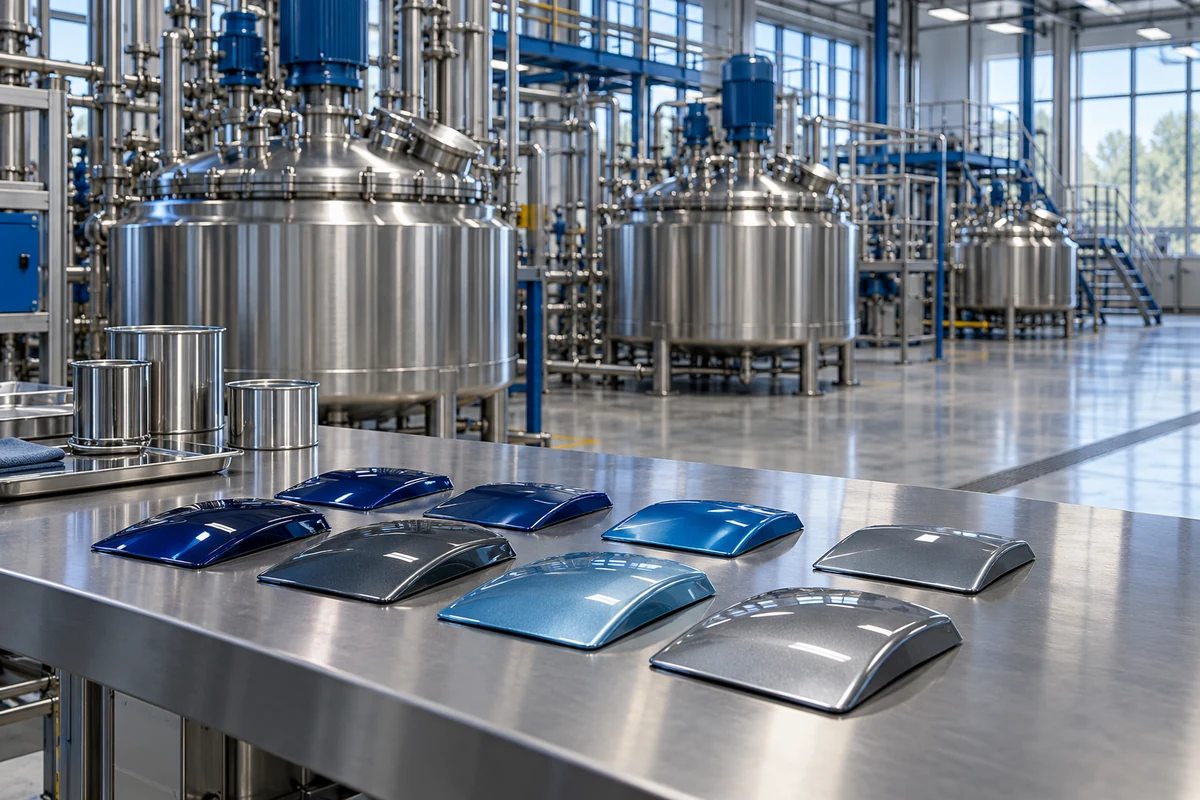
PPG’s May 2024 manufacturing programme placed a planned paint and coatings plant in Loudon County, Tennessee, alongside upgrades at two existing North American sites. The Loudon project carried a $225 million investment commitment within a $300 million programme. Its initial customers were to be automakers and automotive-parts suppliers, with scope to serve transportation, heavy-duty equipment, construction and consumer-product markets later. The plant would become PPG’s first newly built manufacturing facility in the United States in more than fifteen years. The programme addressed the production and supply of coating materials; the vehicle manufacturers receiving them would apply those materials in their own painting operations. PPG was headquartered in Pittsburgh, Pennsylvania, and reported net sales of $18.2 billion in 2023. Its operations extended across more than seventy countries, serving construction, consumer-product, industrial and transportation markets as well as their aftermarkets. Automotive coatings formed one part of that wider business.
The Loudon design called for a building of approximately 250,000 square feet and annual production of more than 11 million gallons once fully operational. PPG committed to 129 new jobs in Tennessee’s economic-development announcement and described the workforce as approximately 130 full-time employees in its own release. These figures referred to the same planned operation at different levels of rounding. Construction was scheduled to begin in August 2024, with completion expected in 2026 under the May plan. In a July 2024 interview, Alisha Bellezza, PPG’s senior vice president for global automotive coatings, gave July 2026 as the expected completion date. Both were project targets, with the workforce and output figures dependent on commissioning and full operation.

Three locations and different investment roles
The remaining $75 million in the programme covered equipment and other improvements at PPG’s facilities in Cleveland, Ohio, and San Juan del Río, Mexico. Those investments were intended to expand manufacturing capabilities and improve processing times at existing operations. Waterborne coatings were among the products for which PPG expected additional demand. The three-location investment programme therefore combined a new site with changes inside an established production network. PPG planned to begin the investments in 2024 and spread them over four years. The company also stated that the programme fitted within its existing overall capital-spending levels, rather than representing an increase in those company-wide spending levels.
PPG chairman and chief executive Tim Knavish associated the investments with modernisation, digitisation, product quality and lower complexity across the manufacturing footprint. Bellezza linked the Tennessee location to proximity to automotive manufacturers and parts suppliers. Her July explanation identified quicker delivery, reduced fuel use and faster responses as expected supply-chain benefits. She also described the southeastern region as being within a day’s drive of approximately two-thirds of the U.S. population. These were the company’s reasons for selecting and expanding production locations. The planned Loudon building combined manufacturing with warehousing, while Cleveland and San Juan del Río retained their roles as existing sites receiving new equipment and processes. TVA, Loudon Utilities, Loudon County, the City of Loudon, the Loudon County Economic Development Agency and the Tennessee Department of Economic and Community Development participated in the economic-development partnership. Their involvement accompanied the company’s investment and employment commitments.

Mixing, automation and the planned product range
The Loudon production plans included waterborne primers, waterborne tints and waterborne basecoats. Bellezza said the facility would use advanced manufacturing equipment and digital tools to improve quality and operational efficiency. New mixing technologies were expected to shorten processing times and allow larger batches. Automated production processes formed part of the planned equipment deployment. The announcement supplied a total annual gallon figure for the site but did not divide that capacity between primers, tints and basecoats. Its production range concerned materials supplied to vehicle makers and their component manufacturers. Broader industrial customers remained a possible subsequent market rather than a separately quantified first-stage production commitment.
Tennessee already hosted several automotive investments when PPG announced Loudon. Volkswagen had begun operations in Chattanooga in 2011 and added electric-vehicle production in 2022. Ford started construction of its $5.6 billion electric-vehicle campus in Stanton in September 2022. Magna subsequently announced $790 million for three Tennessee facilities, including two in Ford’s supplier park. Hyundai supplier Hanon Systems also planned a $170 million thermal-management manufacturing facility in Loudon. Ultium Cells and LG Chem were developing battery and cathode manufacturing operations elsewhere in the state. These projects supplied the regional manufacturing context for PPG’s decision. They were separate companies’ investments, with their own products, construction programmes and customer relationships. Across East Tennessee, more than fifty projects supported by the state economic-development department since 2020 carried approximately 9,700 job commitments and $2.9 billion in capital investment by May 2024. Those regional totals covered multiple businesses and projects.

The coating layers used by vehicle manufacturers
PPG’s automotive original-equipment-manufacturer portfolio covers successive functions in a vehicle’s coating system. Pretreatments prepare metal surfaces, electrocoats provide a corrosion-resistant foundation, primers prepare the surface for later finishes, basecoats supply colour and clearcoats provide the outer finish. The portfolio includes waterborne and solventborne materials, powder primers and scratch-resistant ceramic clearcoats. These categories describe the products and systems offered to customers, rather than a confirmed equipment list for the Loudon factory. A coatings plant manufactures materials that may serve several customers’ paint shops; those customers can use different combinations of layers, substrates and application processes within their own vehicle-production programmes.
Pretreatment materials react with the vehicle’s metal surface to improve adhesion and corrosion performance before the subsequent coating layers are applied. PPG offers systems intended for lightweight and mixed-metal substrates, reflecting the use of different materials within vehicle bodies and components. The company associates these systems with improved finish quality, reduced sludge and lower processing costs. Those benefits are product and process claims, with the outcome dependent on the customer’s application. Pretreatment occupies a different place in the coating sequence from the coloured basecoat or protective clearcoat. It prepares the underlying surface on which the later coating system is built, including the corrosion-resistant primer and topcoat finish.
Electrocoat and the primer options
PPG’s cathodic dip primers form part of its electrocoat range for automotive bodies. The company formulates its automotive cathodic epoxy coatings with zero lead and describes them as having low levels of volatile organic compounds and hazardous air pollutants. Low emissions-related content and zero lead are different formulation statements. PPG also identifies resistance to salt spray, humidity and cyclic corrosion among the intended performance characteristics of these coatings. A smooth electrocoat film provides the foundation for the visible finish applied later. These descriptions concern the supplier’s coating technology; the Loudon investment announcement did not allocate a specific share of the new site’s planned output to electrocoat products.
Primer surfacers are available in several forms. PPG’s powder primers are formulated without solvents, with variants for low-cure processing, sharp-edge protection, dielectric applications and durable automotive trim. Its waterborne primer technology uses proprietary polyester-resin chemistry, with surface appearance, solids content, chip resistance and low film build among the intended characteristics. Solventborne primers offer another option for different application conditions and compatible coating stacks. The choice changes the material and processing requirements within the customer’s paint shop. Loudon’s intended production range included waterborne primers, tints and basecoats, according to Bellezza; the wider product catalogue contains additional technologies beyond that announced initial range.

- Pretreatment prepares the metal surface for adhesion and corrosion performance.
- Electrocoat supplies a corrosion-resistant foundation beneath the later finish.
- Primer surfacer, basecoat and clearcoat have distinct preparation, colour and finishing functions.
- Compact paint systems combine or relocate selected functions within a redesigned application process.
Colour, basecoats and the final clear layer
Basecoats supply the colour and appearance expected in the finished vehicle. PPG offers solventborne and waterborne basecoat systems, including high-solids solventborne products intended to address regional requirements for volatile-organic-compound emissions. Its waterborne range is designed for low VOC levels while retaining appearance, colour, smoothness and chip-protection characteristics. The company supplies technical support for the use of these systems in different regions. The planned production of waterborne tints and basecoats at Loudon belonged to this colour-material part of the automotive portfolio. The investment information did not specify a number of colours, a tint-to-basecoat ratio or a quantity of finished vehicles that the annual gallon capacity would serve.
Clearcoats provide the outer finish over the coloured layer. PPG’s range includes one-component and two-component formulations, matte finishes and scratch-resistant products. These variants enable different appearance and durability specifications within an automotive coating system. They accompany the primers and basecoats in the company’s broader original-equipment portfolio. The product range also extends to automotive parts and accessories, rather than vehicle bodies alone. Bellezza described PPG’s approach as supplying systems for both interior and exterior applications. The commercial investment in coating production and the customer’s choice of a complete finish system therefore concern connected stages of the supply chain, with separate manufacturing and application operations.

B1:B2 combines functions in the topcoat process
PPG’s B1:B2 compact paint system removes the standalone primer application stage and its dedicated booth. The B1 layer takes on primer, filling, chip-resistance and durability functions. The B2 layer provides colour and additional durability. Both layers are applied wet-on-wet without a baking or heated-dehydration process between them. PPG offers the system in waterborne and solventborne versions. The removal of a separate application stage does not mean that the primer’s functions disappear: those functions move into the B1 material. This is a redesign of the vehicle maker’s painting process, with a different arrangement of coating functions and associated equipment from a conventional standalone-primer sequence.
The compact paint-system portfolio also includes 3C1B. That approach moves traditional primer application into the topcoat booth and permits wet-on-wet-on-wet application of primer, basecoat and clearcoat. The layers are specifically engineered for the revised process. Solventborne versions can operate with or without a heated flash on the primer. Waterborne versions require a heated primer flash before the basecoat and clearcoat are applied. That requirement differs from the stated B1:B2 arrangement between its two layers. PPG lists the systems separately because the coating materials and the application sequence are coordinated parts of each process design.

Process benefits and the manufacturing programme
PPG associates its compact systems with a smaller paint-shop footprint, reduced energy consumption and lower capital and operating costs. It also identifies reductions in VOC emissions and associated carbon-dioxide emissions among the intended customer benefits. Removing or relocating a primer application stage changes the booths and processing operations required for that particular system. These are benefits claimed for the customer’s coating application process. The 2024 Loudon materials-production announcement separately identified automation, mixing equipment, digital tools and a larger supply capability. Neither description supplied a measured Loudon energy-saving percentage, a carbon reduction per gallon or a verified improvement in a customer’s production rate resulting from the proposed new factory.
Bellezza’s automotive planning covered vehicle production volumes, sales, new model launches and the share of electric vehicles. In July 2024, she described changes in powertrains, autonomous technologies and ride-sharing as part of a broader industry transition. She also observed that automotive sales and production had not returned to pre-pandemic levels or the earlier peak around 2017. Her expectation was that electric powertrains would create additional functional uses for coatings within each vehicle, beyond the visible body finish. That was a company executive’s assessment of the market opportunity. It accompanied the planned waterborne production and supply-network changes rather than a disclosed sales forecast for the Loudon operation.

Separate investments in powder coatings and battery testing
PPG’s wider investment activity included a $44 million programme announced in 2023 for five powder-coating manufacturing facilities in the U.S. and Latin America. Bellezza described that programme as an expansion of powder-product offerings and production capacity. Its five-site scope and 2023 announcement were separate from the $300 million automotive manufacturing programme announced in 2024. Powder products also form a different category from the waterborne primers, tints and basecoats named for Loudon. Across the automotive portfolio, PPG offers powder technologies for functions including primers, trim protection and electrical insulation, alongside liquid coating systems. Those product categories explain the different types of manufacturing and customer applications within the company’s investment activity.
A further 2023 investment was a $30 million battery-pack application centre in China, with capabilities for testing coatings, materials and systems used in electric-vehicle battery packs. Bellezza cited the centre as part of PPG’s global customer-support activity. Testing and application development serve a different purpose from the bulk manufacturing capacity planned in Tennessee. The May 2024 investment programme comprised a new Loudon plant, improvements in Cleveland and San Juan del Río, and a four-year programme beginning in 2024. The proposed July 2026 completion, full-operation workforce and annual gallon capacity remained dated project expectations.
Leave a comment