
Industrial garnet: Lucky Bay’s production chain and restructuring
Garnet grading, processing bottlenecks and the financing record connect Lucky Bay’s 2024 ramp-up with its 2025 restructuring and later operating decision.
Administrators appointed at Lucky Bay
Resource Development Group entered voluntary administration on 28 July 2025 together with six subsidiaries. Jason Ireland, Rob Brauer and Linda Smith of McGrathNicol became administrators. They intended to keep the Lucky Bay garnet operation running while pursuing a sale or recapitalisation. Mineral Resources, which held 64.31% of RDG and was a secured creditor, had declined a cash advance before the appointment. It subsequently offered administration funding, with terms still being finalised when the appointment was announced. RDG's shares remained suspended from trading.
Lucky Bay produces industrial garnet in Australia, in the Mid West region of Western Australia, between Kalbarri and Port Gregory. Australian Garnet, then an RDG subsidiary, held two granted mining leases covering 1,572 hectares and two exploration licences covering 7,394 hectares. The project lies about 530 kilometres north of Perth and 35 kilometres south of Kalbarri. Its Menari and Menari North deposits supply a processing chain that includes wet concentration, drying, mineral separation and screening. Products go to abrasive blasting and waterjet cutting customers through an international distributor network.
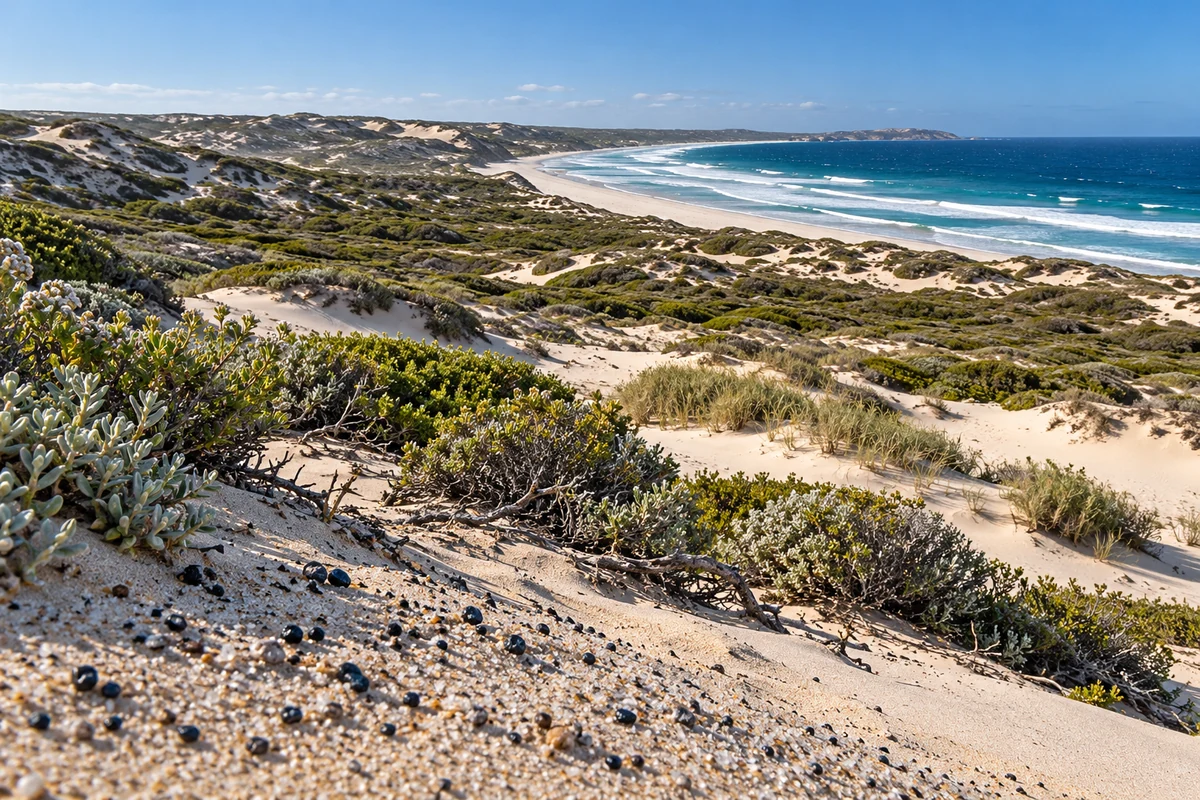
The deposit before the restructuring
RDG acquired Lucky Bay, formerly the Balline Garnet Project, in February 2021. Exploration subsequently extended the known mineralisation northwards. An updated estimate announced on 11 September 2023 increased the combined Lucky Bay and Lucky Bay North resource from 442.5 million tonnes to 523.3 million tonnes, an 18% increase in total material. Contained heavy minerals increased from 19 million tonnes to 21.7 million tonnes, while contained garnet increased from 15.9 million tonnes to 17.9 million tonnes. These figures were geological resource estimates, rather than finished abrasive available for sale.
The combined August 2023 estimate used a 2% heavy-mineral cutoff. Its measured category contained 41.2 million tonnes of material, the indicated category 432 million tonnes and the inferred category 50.1 million tonnes. Measured and indicated material together accounted for about 90% of the total. The combined heavy-mineral grade was 4.15%, and garnet represented 82.4% of the heavy-mineral assemblage. Lucky Bay North contributed 117.6 million tonnes of material and 3.2 million tonnes of contained garnet. The separate Lucky Bay estimate contained 405.7 million tonnes and 14.7 million tonnes of garnet.
Exploration and the mineral-sands setting
RDG's March 2021 aircore program comprised 103 holes totalling 2,935 metres. Earlier exploration included drilling by Westralian Sands, Iluka Resources and Haddington Resources, followed by programs in 2016 and 2020. Further work in November 2022 included analysis of nongarnet heavy minerals in both Lucky Bay areas. The 2023 resource update extended the June 2022 resource approximately three kilometres northwards. Its depletion adjustment covered 0.3 million tonnes of mined material at 28 June 2023, which had yielded 0.01 million tonnes of heavy-mineral concentrate and 0.006 million tonnes of recovered garnet.

Garnet occurs in several geological settings, including metamorphic rocks and weathered mineral-sands deposits. Geoscience Australia gives its relative density as 3.5–4.3 grams per cubic centimetre and its hardness as 6–7.5 on the Mohs scale. Its resistance to abrasion and chemical weathering allows grains to persist in strongly weathered material and dunes. Industrial grains differ from the large transparent crystals selected for jewellery. In wet processing, liquid and separation equipment remove lighter material; subsequent dry processing can include drying, magnetic separation and vibrating screens for size classification.
Commissioning and the wet concentration circuit
Australian Garnet commissioned and optimised Lucky Bay's wet and dry processing plants during the 2023 financial year and began ramping up production. During the following year, plant performance problems required modifications. RDG's construction subsidiary Central Systems performed civil, mechanical and electrical work on the process plant. Managing director Andrew Ellison identified Australian Garnet's operating difficulties alongside stronger construction activity elsewhere in the group in his letter for the year ended 30 June 2024. Recruitment covered both temporary construction roles and permanent positions at the garnet operation.
At the wet concentrator, the original constant density tank had caused instability in the sand feed to the rougher spirals. Australian Garnet installed and commissioned an upgraded tank in July 2024. The company associated the change with steadier operation, better heavy-mineral recovery and higher throughput. Two additional attritioners had already been commissioned in June. They expanded the circuit used to remove residual calcite coatings from garnet grains. Calcite remaining on the grains could release dust when the finished abrasive was used in blasting, making the cleaning stage relevant to product quality.

The dryer and screening upgrade program
The existing heavy-mineral concentrate dryer could not provide the throughput required by the production plan. Its restricted output reduced feed into the mineral separation plant and, subsequently, the sand screening plant. Australian Garnet began installing a larger rotary kiln dryer. By 22 August 2024, its concrete footings were complete; installation was scheduled to continue in September, with commissioning due to begin on 15 October. The original dryer was to remain available as standby equipment during planned maintenance of the larger unit or for a possible future expansion.
The screening upgrade had a separate timetable. Design work was complete and procurement well advanced in August 2024, with commissioning forecast for the first quarter of 2025. Australian Garnet intended the expanded screening capacity to provide greater flexibility for individual customer requirements. Ellison expected the larger dryer to increase production capacity after commissioning. Both dates were forward plans at that stage. The 22 August 2024 project update set out the commissioned wet-processing changes separately from the dryer and screening projects still being installed or procured.
Moving mining and tailings into the pit
Australian Garnet relocated its mining unit plant onto the floor of the eastern strand of the Menari pit during 2024. A loader operated beside the unit, reducing the distance it travelled with material, while a dozer pushed ore down to assist blending and maintenance of the working face. The unit was to move periodically along the pit floor as the face advanced. Modifications to the unit were intended to shorten relocation shutdowns and increase operating time. These changes formed part of the transition from the interim mining arrangement to the longer-term operating layout.
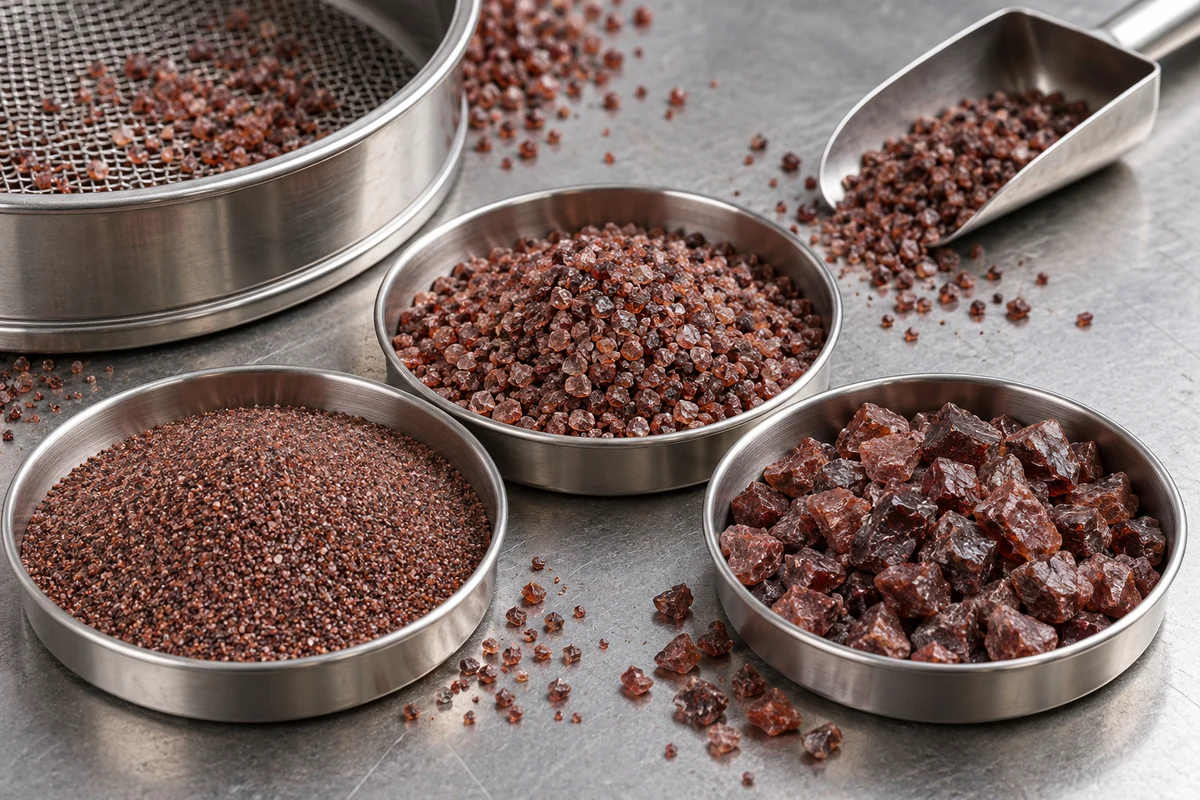
Mining had started at the deposit's southern end and progressed north far enough for sand tailings to be returned to the excavated pit. In-pit tailings disposal began in June 2024. Previously, tailings had been stored outside the mining path south of the processing plant. Profiling and rehabilitation of that area were already under way during the relatively wet conditions of 2024. The future in-pit rehabilitation sequence involved shaping the sand into a natural landform before returning topsoil and vegetation. Those planned steps were distinct from the off-path rehabilitation that had already started.
Water, drilling and operating certification
Sand tailings discharge was the project's main source of water loss. Australian Garnet had introduced recovery improvements after initial commissioning and was designing changes to tailings stacking to recover more water. Additional bores extended the monitoring network used to examine aquifer capacity and seasonal variation. A completed grade-control drilling program covered planned mining areas for the next 18 months, providing information on garnet particle-size distribution for the mining schedule. Heritage surveys north of the leases were being arranged with the Yamatji Southern Regional Corporation before further exploration drilling.
Australian Garnet was also seeking ISO 9001 quality, ISO 45001 occupational health and safety, and ISO 14001 environmental management certification. Stage one had been completed by August 2024, with completion of the program targeted before year end. At that reporting point, the operation recorded a lost-time injury frequency rate of zero and a total recordable injury frequency rate of 1.04 since work began on site. RDG's annual group figures used a different reporting boundary: a rolling 12-month TRIFR of 1.1 at 30 June 2024 and no lost-time injuries.

Wind power beside the mine
Lucky Bay's wind farm has seven turbines rated at 600 kilowatts each, giving 4.2 megawatts of installed capacity. The turbines came from Germany and began contributing electricity to the mine grid in late 2023. Software and power-management upgrades subsequently improved their integration with the process plant's power supply. Ellison identified electricity as the operation's second-largest cost in August 2024. The company associated wind generation with reduced diesel consumption and lower overall site power costs, without publishing a complete product-by-product energy-cost account in that update.
The Clean Energy Regulator accredited the wind farm as a power station, enabling Large-scale Generation Certificates to be created with effect from October 2023, its first month of generation. RDG included that accreditation in both its August operating update and its 2024 annual report. The seven turbines, the mine's processing equipment and the remaining site power supply were connected through the mine grid. The disclosed improvements concerned that integration; the installed wind rating was not a statement that the plant received 4.2 megawatts continuously or operated entirely without other power sources.
Products and international customers
Australian Garnet's assortment included 20/40 mesh, 30/60 mesh, 80 mesh and 120 mesh products. The company supplied abrasive blasting markets in steel fabrication, oil and gas, infrastructure, pipelines and shipbuilding. Waterjet applications included cutting thick metal and stone as well as glass and electronic components. Distributor agreements covered Australia, Asia, Europe, the Middle East and the United States. Finished products were already being shipped into these regions in August 2024. The company expressed confidence in demand and customer feedback; those assessments remained its commercial views.

The US Geological Survey's January 2025 garnet summary estimated 2024 world mine production at 980,000 tonnes, including 390,000 tonnes in Australia, 310,000 tonnes in China and 180,000 tonnes in South Africa. United States crude production was estimated at 80,000 tonnes, refined material sold or used at 140,000 tonnes and apparent consumption at 160,000 tonnes. US imports fell to an estimated 100,000 tonnes from 151,000 tonnes in 2023. These national and world figures covered industrial garnet, excluding gem and synthetic garnet.
Funding and the July 2025 administration
Mineral Resources' RDG loan balance stood at A$145 million on 30 June 2025, compared with A$117 million at the previous year end. The administrators' appointment the following month constituted an event of default under that agreement. Mineral Resources issued a default notice and agreed to provide separate funding for the administration. By its 2025 financial report, the secured administration term loan had a ceiling of A$14.5 million, of which A$6.5 million had been advanced. It carried interest of 12% a year.
The administration funding arrangement extended to the relevant end of the administration period or, if creditors approved the proposal, effectuation of the deed of company arrangement. On 25 August 2025, the administrators' report to creditors included Mineral Resources' formal proposal to acquire the subsidiaries and assets while excluding RDG itself. Creditors were due to vote on 1 September. RDG was still consolidated in Mineral Resources' accounts at the 30 June balance date; the later appointment required a separate assessment of control after that date.

Shares, settlement and the asset transaction
RDG's ordinary shares were suspended from official quotation from 28 July 2025. ASX Settlement suspended their CHESS approval from 30 July. During that suspension, CHESS would not process messages affecting holder registration details. Transfers and conversions also required written administrator consent or a court order under the conditions in the settlement notice. These measures applied to the listed securities while the administrators pursued continued operation and a transaction for the underlying business. The first creditors' meeting had initially been expected on 7 August.
Creditors approved Mineral Resources' proposed deed of company arrangement on 1 September 2025. Separate deeds were executed for the entities in administration on 22 September, and a binding asset and share sale agreement was publicly announced on 23 September. Mineral Resources' board handled decisions about RDG and the acquisition without managing director Chris Ellison or its nominees on RDG's board participating in deliberations. Chair Malcolm Bundey linked that arrangement to managing perceived conflicts and realising value from the group's investment. He also thanked employees for continuing to work safely during the process.

Ownership changes and the 2026 operating decision
Mineral Resources acquired all RDG's shares in the operating subsidiaries, increasing its ownership interest in those businesses from 64.31% to 100%. Its loans to RDG, including the administration facility, were forgiven and extinguished. All nonrelated creditor and employee claims on the RDG group were repaid. The subsidiary deeds were effectuated on 25 September 2025. Mineral Resources ceased controlling the parent RDG and deconsolidated that entity, while continuing to consolidate the subsidiaries. Those transaction outcomes appeared in its half-year financial statements for the period ended 31 December 2025.
Mineral Resources announced on 25 June 2026 that Lucky Bay would stop operating and enter care and maintenance from 1 July. The company attributed pressure on financial performance to the Middle East conflict, which affected an important sales region, together with higher diesel and shipping costs. Approximately 110 employees were affected, with support and redeployment opportunities to be offered where suitable. The company planned to examine options including a potential divestment. Its June 2026 announcement also identified a noncash impairment relating to an approximately A$40 million written-down value for disclosure in the full-year results.

Key stages in the Lucky Bay record
- February 2021: RDG acquired the former Balline Garnet Project.
- September 2023: the combined resource estimate reached 523.3 million tonnes of material containing 17.9 million tonnes of garnet.
- June–July 2024: additional attrition capacity and a redesigned constant density tank were commissioned.
- July 2025: administrators were appointed to RDG and six subsidiaries.
- September 2025: the asset transaction transferred the operating subsidiaries to Mineral Resources.
- June 2026: Mineral Resources announced care and maintenance effective from 1 July.
Leave a comment