
ANCA’s 2030 strategy: targets, people and precision manufacturing
ANCA’s 2025–2030 strategy links emissions targets, workforce development and supply-chain plans with the company’s precision-manufacturing capabilities.
ANCA introduced its first Sustainability Strategy 2025–2030 in July 2025, setting company-wide commitments alongside its precision-engineering business. The Melbourne-based manufacturer aims to cut absolute Scope 1 and 2 greenhouse gas emissions by 42% and absolute Scope 3 emissions by 25% by 2030, using 2023 as the base year. Energy-efficiency measures, renewable energy and cooperation with supply-chain partners are the proposed routes. Chief executive Martin U. Ripple described the strategy as a continuing commitment to changing how the business designs, manufactures and operates. The targets concern future reductions, rather than completed savings. Australian Manufacturing covered the launch on 28 July 2025, with workforce development, circularity and logistics included alongside emissions.
A manufacturing business built around control
Pat Boland and Pat McCluskey founded ANCA in 1974 after buying a mini-computer for A$4,000. Their initial idea was to replace hardwired machine controls with a standard computer. The company subsequently developed CNC grinding machines, motion controls and manufacturing solutions. Its first overseas branch opened in Novi, Michigan, in 1986; branches in England and Germany followed in 1988 and 1991. ANCA’s current company profile describes more than 1,000 employees, customers in over 45 countries and exports accounting for 99% of its products. Headquarters remain in Melbourne, Australia. The group also includes ANCA Motion, established in 2008, and ANCA Manufacturing Solutions, operating since 2000. The latter began with machine canopies and expanded into design, manufacturing, coatings and assembly. ANCA describes extensive in-house development across machines, controls and software, supported by an international sales and service network.

A Sustainability Steering Committee is responsible for developing, implementing and monitoring the group plan. Operations drives the committee, with representation from the chief executive, finance, human resources, infrastructure management and business units. The committee supplies regular updates to the board on progress, risks and opportunities. ANCA also used a double-materiality assessment: financial materiality addresses how sustainability factors affect the business’s financial prospects, while impact materiality concerns the business’s effects on society and the environment. These are the governance arrangements and assessment categories adopted for its strategy.
A six-year implementation programme
The published strategy document assigns responsibilities across reporting, strategy review, global projects and capital budgets. The chief executive has final approval; operations facilitates and coordinates. Finance collects financial positions and validates financial assessments for the annual sustainability report. Communications formats the report, human resources collects diversity data, safety supplies safety information, infrastructure management liaises with energy companies, and supply-chain staff address logistics and modern slavery. Business-unit heads contribute strategic alignment, while engineering contributes product development to strategy updates. Implementation is planned across 2025–2030, progressing from a foundation stage through early implementation, acceleration, scaling, refinement and expansion to target achievement and future planning. This is ANCA’s programme of work and allocation of responsibilities, with the final target horizon in 2030.
ANCA’s people commitments include maintaining a Lost Time Injury Frequency Rate of six or below, with zero harm as its ultimate goal. Apprenticeships, graduate programmes and LEAN training support development. The company plans to increase female representation, develop leadership and implement a supplier code of conduct. Logistics proposals include route optimisation and lower-emission vehicles. Circularity plans cover recyclability, take-back programmes and reuse or recycling of manufacturing waste.
Engineering experience beyond the factory
ANCA supports student engineering through sponsorship and industry engagement. The RMIT Rover Team designs, builds, integrates and tests a semi-autonomous lunar rover for the Australian Rover Challenge; its 2026–2027 development cycle includes mechanical, electrical, software and operations work, with an ANCA Bayswater visit included in the company’s description of support. The Melbourne Space Program gives university students experience in complex technology projects, including the ACRUX-1 nano-satellite. Monash High Powered Rocketry develops rockets for competition categories at 10,000 and 30,000 feet. MUR Motorsports brings mechanical, mechatronic and electrical engineering students together to develop an electric racing vehicle over a twelve-month cycle. ANCA has also donated a Magna400 sixteen-inch electronic height gauge to Oakland Community College’s Machine Tool Lab. These are distinct education and equipment-support activities described by the company, including current projects and its retrospective account of the donation.

Senior mechanical engineer Hugh designs hardware for customised grinding and automation solutions. His work involves both the mechanical design and the grinding process. He began at ANCA in testing and development, moved into grinding applications with customer visits internationally, and then entered mechanical design. That progression included a two-year role at the branch in Germany. In his company profile, Hugh describes the satisfaction of taking a design from the computer into assembly and operation. He also regards the overseas move as a demanding period of learning that increased his independence. The profile presents a particular employee’s experience across testing, applications and design, rather than a universal career sequence. His account connects practical assembly with engineering work and customer-facing experience.
Senior software engineer Barbara works on user interfaces, algorithms, structured models, databases, architecture and data analysis. Her ANCA profile describes collaborative problem-solving across different disciplines and backgrounds. She has also become a Scrum Master and developed a component for a machine under development at the time of her account. Barbara identifies the exchange of concepts and ideas with colleagues as an important part of her role. Outside the company she shares programming knowledge as a co-organiser of the Melb.Net meetup. Her description supplies a software counterpart to Hugh’s mechanical work: the product-development organisation includes interface design, mathematical and data-oriented tasks, and coordination within engineering teams. These are responsibilities and experiences attributed to the employees in their individual profiles, with no assumption that every role follows the same pattern.

Machines, blanks and thermal stability
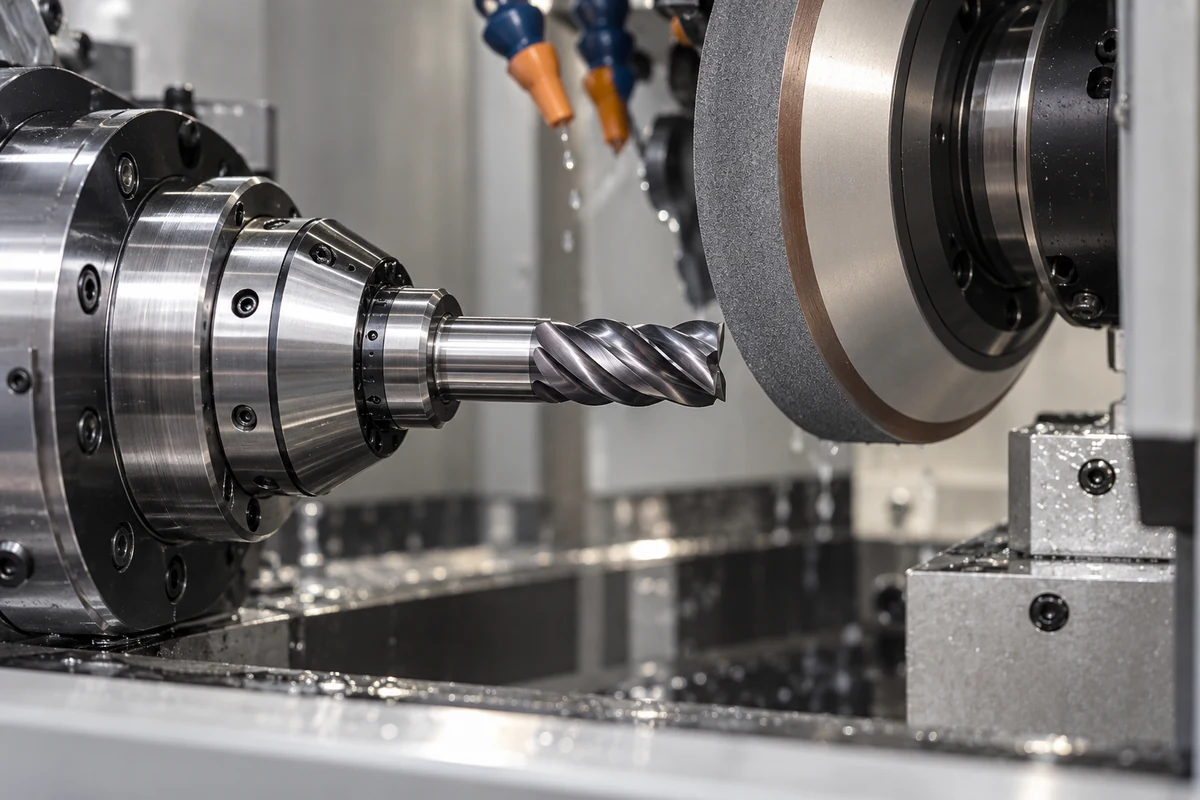
The FX5 ULTRA tool grinder uses a control system with one-nanometre resolution on linear axes and one microdegree on the rotary axis. ANCA distinguishes that control resolution from the machine’s other specifications. The machine has a 12 kW peak grinding spindle, a two-station automatic wheel changer and automatic headstock clamping. The company describes capability for micro-tools down to 0.1 mm diameter, while its specification lists productive shank diameters up to 12 mm and a maximum tool length of 300 mm, subject to tooling. Loading options include ANCA’s AR300 and a Fanuc 200iD robot. The FX5 ULTRA also incorporates in-process measurement, balancing, runout compensation and Motor Temperature Control. ToolRoom RN34 software is offered for designing and producing complex cutting tools, including applications in medical, electronics and consumer-device manufacturing. The specifications describe a machine’s available functions; nanometre control resolution is a different quantity from finished-tool accuracy.
The CPX Linear prepares tool blanks using pinch-peel grinding on a four-axis machine. It has separate roughing and finishing wheel packs, with peak spindle powers of 43 kW and 9.7 kW. ANCA specifies linear motors on the X, Y and V′ axes and BlankX programming software. A removable tailstock supports long, slender blanks: the published accessory range covers lengths from 90 to 360 mm and diameters from 1 to 25.4 mm, for carbide and high-speed steel. The company gives a setup time of fifteen minutes or less when changing the tailstock arm and live centre. A separate Whitestick assembly conditions the finishing wheel, removing swarf and restoring its cutting action. It accepts 25 × 15 × 100 mm sticks and has a stated setup time below ten minutes. Both accessories are described as retrofittable to existing CPX Linear machines, extending the available configuration of installed equipment.

Motor Temperature Control, or MTC, manages the grinding-spindle motor’s temperature by adjusting motor operating efficiency. The system uses sensor monitoring and algorithms in the spindle-drive firmware to maintain a set temperature despite changes in speed or load. ANCA says the purpose is faster thermal stability and more consistent dimensions between parts. MTC is standard on ULTRA, CPX and GCX spindle motors and optional on other ANCA machines; retrofit kits are offered for older machines. The company states that the firmware approach requires no additional components to deliver the described function. The operating variable here is motor temperature, with dimensional consistency and warm-up behaviour as the stated benefits. ANCA supplies these as technical and productivity claims for the control system. The description does not provide a measured percentage reduction in electricity use for an individual machine or a completed reduction against the group’s 2030 emissions targets.
Balancing and measurement during production
iBalance monitors grinding-wheel vibration and guides the operator through correcting an out-of-balance wheel pack. The software uses hardware already installed in the machine. Balancing takes place with the wheel pack mounted at the grinding position and running at the relevant rotational speed. The user interface first identifies the imbalance and then supplies a sequence of corrective steps. ANCA associates balanced wheels with better surface finish, less vibration and reduced wheel wear. Those are the manufacturer’s stated benefits; the product is a practical balancing function rather than a separate external measuring installation. Keeping the wheel pack in its working position is part of the described method, and the system adds no separate balancing hardware to maintain. Within the machine-tool portfolio, this addresses the condition of the abrasive wheel, while tool geometry is measured through other functions.
LaserUltra measures cutting-tool dimensions inside the grinder without removing the tool. A built-in laser probe measures both the top and bottom to obtain an absolute diameter. ANCA specifies in-process measurement within ±2 microns or less and lists supported measurement and compensation functions in iGrind. These include outer diameters, corner radii, ballnose forms and other profile-tool geometries. End-of-tool and eccentric-runout features can also be digitised and measured. The non-contact probe avoids touching fragile micro-tools, while a controlled air blast clears coolant and contamination before measurement. The software can calculate process stability and capability. Measurement and compensation are separate listed functions: some supported operations provide digitising only, while others also adjust the grinding process. The system therefore combines a physical optical measurement with software functions appropriate to the selected tool geometry.
Loading, marking and finishing
The AR300 loader transfers a tool directly from the pallet to the collet in one gripping action. A double set of grippers supports unloading and loading, with a published fifteen-second cycle for tool exchange. The product page lists tool diameters from 2 to 20 mm. For FX5 Linear machines, a collet-loading option handles the collet and tool together in approximately twenty-five seconds. That option supports mixed-diameter batches using Nikken KM and NK collets. The Loadermate workstation allows grinding parameters to be entered for each tool and assigned to a pallet position; a mixed pallet can be prepared for automatic resharpening while another batch is running. The robot fits within the machine canopy. CPX Linear versions use a different gripper arrangement and pallets from the FX Linear implementation, so the available configuration depends on the host machine and task.

AutoMarkX is a standalone automatic laser-marking station with a robot loader. It accepts tools from 3 to 32 mm in diameter, up to 350 mm long and weighing up to 1.5 kg. The laser source is a 20 W fibre laser with a wavelength of 1,064 nm and a 110 × 110 mm marking field. ANCA gives a typical cycle of twelve to fifteen seconds for pickup, marking and replacement. Rotary workholding allows marking on opposite sides of the shank and at the end of the tool, including unique identification codes. Options include mixed tool batches, different pallet standards and external database or ERP integration. Fume extraction is supplied as a separate module, and oil containment uses a moat and drain. The unit can operate within AIMS for automated production or as a separate marking station.
The EPX-SF stream-finishing machine immerses cutting tools in a rotating barrel of media. It has eleven controlled axes and three independent workheads, with Robomate loading for automated handling. ANCA lists tool diameters from 3 to 25.4 mm, lengths from 50 to 250 mm and a maximum workpiece weight of 4 kg. The drum diameter is 940 mm and the media volume 168 litres; the listed media type is dry. Programmable multi-step processes control the treatment of the tool edge and surface after grinding. The machine also includes dust filtration, an anti-collision system, a column lock for maintenance and hands-off drum replacement. AIMS Connect links it with factory data systems. ANCA markets the finishing process as improving tool life and coating quality; those performance statements remain supplier claims rather than independently measured results for every material, geometry and process setting.

Connecting operations and the group plan
AIMS, the ANCA Integrated Manufacturing System, combines process connectivity, automated handling and workflow creation. AIMS Connect checks whether a tool’s required manufacturing steps are followed and guides manual tasks. AIMS Automate uses robots for transport and palletising, with scheduling to supply machines and move tools for measurement. AIMS Create defines workflows and recipes and links work requests with production orders. The central server connects production schedules through ERP and MES integration. AutoComp transfers measurement data between ZOLLER equipment and grinders so grinding parameters can be compensated when required. AutoFetch moves tools for measurement and returns them to their original pallet pocket. AutoSet prepares and stores production pallets; larger installations can use it for automatic storage and retrieval. Third-party machines and stations can be integrated within the open system. The components handle distinct parts of the production sequence, from preparation and movement to measurement-data exchange.
ANCA also has offices in Thailand. The group plans to use IoT and predictive maintenance to improve operational efficiency and extend product life. Ripple connects innovation with intended environmental and social outcomes, while product redesign and waste reduction remain elements of the 2025–2030 programme.
- Emissions commitments: absolute reductions against the 2023 base year, with a 2030 target horizon.
- Production capabilities: thermal control, wheel balancing, measurement, compensation and automated handling.
- People and suppliers: training, workforce-development plans and engagement beyond the factory.
Leave a comment