
Millicent mill: tissue production, waste recovery and packaging changes
Kimberly-Clark’s Millicent mill combines tissue manufacturing with separate waste-recovery routes, packaging changes and regional water infrastructure.
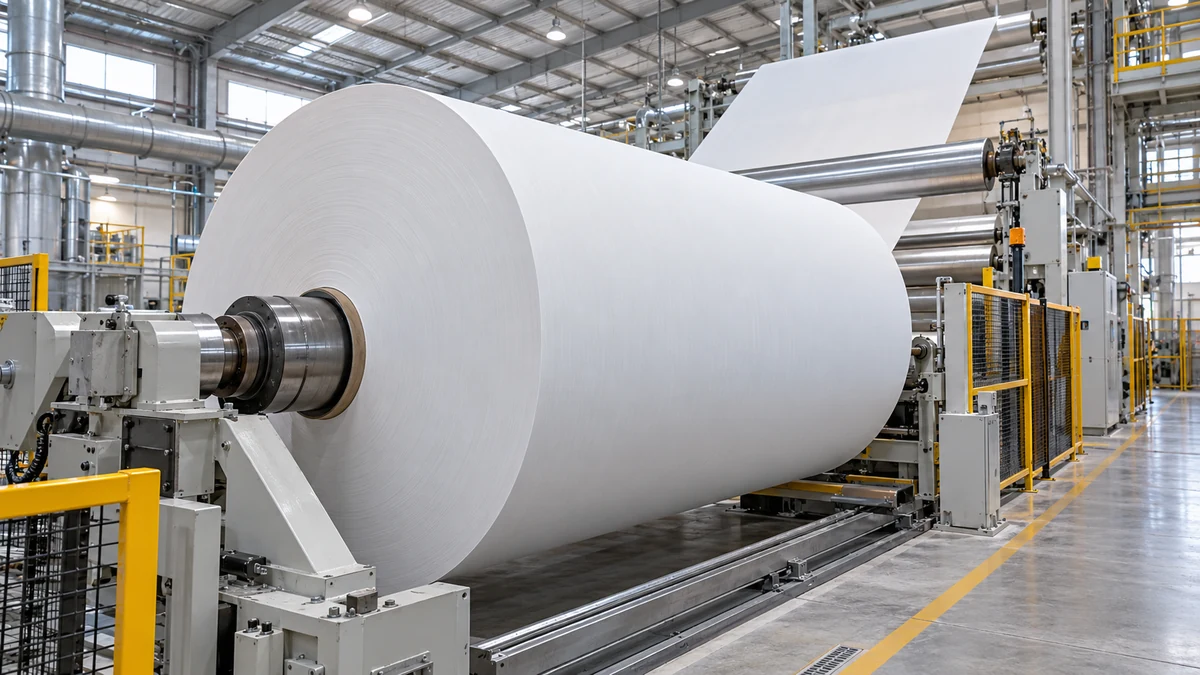
A tissue mill in regional South Australia
Kimberly-Clark’s Millicent mill manufactures toilet tissue, facial tissue and paper towels in South Australia. Annual production was described as 85,000 tonnes when the company announced its landfill-diversion milestone in May 2024. The mill’s operational programmes cover several different activities: handling manufacturing residues, changing the packaging around finished products, reducing operational emissions and maintaining the equipment used to make tissue. These activities have their own measurements and partners. The 9 May 2024 report in Australian Manufacturing, by Kate B., carried Kimberly-Clark’s statement that the facility had diverted all its waste from landfill. That statement concerns the destination of the mill’s waste; it does not describe the elimination of material residues from production or establish that every recovered material returned to another tissue product.
The site has a long manufacturing history in the state’s south-east. Kimberly-Clark marked 60 years in South Australia in 2020, and its regional sustainability account for 2023 described the value of the mill’s outputs as exceeding A$400 million. That is a company-stated value of production, rather than a disclosed operating profit or a valuation of the factory. The same account connected the site with investment in employees, productivity and environmental programmes. Its regional position also appears in practical relationships with external organisations: ResourceCo receives residual material for energy recovery, Woolworths participates in a packaging project, and the Country Fire Service has been given access to a mill water-treatment pond. Each relationship involves a different part of the operation, from material leaving the production site to infrastructure serving the surrounding region.

The landfill-diversion milestone
Millicent reached 100% onsite landfill diversion in November 2023, according to Kimberly-Clark’s Australia and New Zealand sustainability snapshot for that reporting year. The company had been operating at approximately 98% diversion for the preceding couple of years. Its account identified an outlet for the remaining two to three percent: ResourceCo would turn that residual waste into energy to help power its Adelaide plant. The May 2024 announcement used a rounded description of a final two percent. These are descriptions of the same last portion of waste, with slightly different rounding, rather than separate quantities to add together. The November date identifies when the company says the milestone was achieved; the subsequent May coverage is the announcement date used for this article.
The mill used several recovery routes before adding the outlet for its remaining waste. Organic-based materials were managed offsite through composting, including loose cardboard and off-quality tissue-related materials identified in the company’s account. Used fabrics and felts were repurposed in the community, with remaining material directed to landscaping uses. Batteries were collected onsite for recycling. Plastic pails and damaged plastic pallets were also collected and processed into chips for reuse. These routes involve different materials and destinations, so the overall landfill-diversion figure should retain its broader wording. A compact inventory of the reported pathways separates the material types without implying that every route has an identical process or produces the same recovered output:

- Organic-based tissue and cardboard materials: offsite composting, as described by the company for the specified manufacturing residues.
- Used fabrics and felts: community reuse, with remaining material used for landscaping.
- Collected batteries, plastic pails and damaged plastic pallets: separate recycling arrangements, including plastics processed into chips.
- The residual portion without the earlier recovery outlets: conversion to energy through the ResourceCo partnership in Adelaide.
Different destinations for manufacturing residues
Fabrics, felts, pails and pallets sit alongside paper-based residues in the mill’s recovery arrangements. The programme therefore concerns more than the finished tissue products sold to consumers. The company describes community reuse for used fabrics and felts and a further landscaping destination for remaining material; it describes plastic pails and damaged pallets as a collected stream that becomes chips for reuse. Those are distinct steps in handling materials associated with factory operations and distribution.
ResourceCo’s role concerns the small residual fraction that remained after the earlier recovery arrangements. Kimberly-Clark’s 2023 account places the receiving energy use at ResourceCo’s Adelaide plant, rather than describing the material as fuel already returned to Millicent’s tissue-making equipment. The distinction matters to the physical route: the waste leaves the mill and is used through an external partner. The company’s account of 100% landfill diversion includes that energy-recovery destination alongside the other outlets. It does not provide an independently verified lifecycle comparison between all of the pathways, or a separate emissions figure for transporting and treating the residual stream. The recorded achievement remains the stated diversion from landfill; a claim of complete material recycling would assign a different meaning to the final portion.

Emissions targets and explored energy options
Millicent’s waste programme sits alongside a separately measured operational emissions programme. In its 2023 regional sustainability snapshot, Kimberly-Clark reported a 30.5% reduction in the mill’s Scope 1 and Scope 2 emissions against a 2015 baseline. The stated target was a 50% reduction by 2030. Mill manager Adam Carpenter discussed the same direction in May 2024, describing a reduction of more than 30% as of 2023 and saying the earlier greenhouse-gas reduction goal had been surpassed in 2022. The more precise 30.5% figure and its baseline belong to the company’s reporting. Neither the waste-diversion percentage nor the 85,000-tonne production figure supplies a replacement emissions baseline.
Kimberly-Clark was exploring green hydrogen as an alternative energy source when it announced the waste milestone. Carpenter also referred to work with industry and government partners to pursue further reductions. The company’s climate page describes continued exploration of alternative renewable energy sources at Millicent, while its regional account refers to possible energy sources and upgrades. These statements identify work under consideration; they do not confirm that a hydrogen installation was commissioned at the mill or quantify a completed fuel substitution. The company also has a separate global target concerning emissions from purchased goods and services and the end-of-life treatment of sold products. That wider ambition should not be substituted for the mill’s stated Scope 1 and Scope 2 reduction target, which has its own 2015 comparison year.
Reducing and replacing packaging material
During 2023, the team at the South Australian manufacturing facility reduced the thickness of the bundling wrap used on certain products. Kimberly-Clark put the resulting annual plastic reduction at 62 tonnes. A further change to Kimberly-Clark Professional Scott toilet-paper bundles was reported to save another 12.6 tonnes each year. Both figures concern packaging changes, not a reduction in the amount of tissue manufactured. The first change retained a thinner version of a wrapping material; the Scott figure concerned a separate packaging adjustment. The regional account describes secondary wrapping as a way of meeting logistics and customer requirements. These annualised packaging figures are separate from the percentage of factory waste diverted from landfill, and the available descriptions do not allocate either figure across every product made at Millicent.
Another 2023 packaging measure introduced recycled content rather than removing the packaging altogether. Kimberly-Clark said Viva paper-towel and Kleenex toilet-paper packaging, including products sold through its Professional business, contained 20% recycled material. It estimated that this avoided more than 100 tonnes of virgin plastic a year. Recycled content and reduced packaging weight describe different changes: the former replaces a portion of the input material, while the latter reduces the quantity used. The 20% statement applies to the identified packaging, not to the composition of the tissue inside it or to all packaging across the company. The annual virgin-plastic estimate also has a different scope from the 62-tonne bundling-wrap change, so the figures are retained separately rather than presented as an audited, combined mill total.

The Viva and Woolworths trial
In November 2024, Kimberly-Clark and Woolworths described a further change involving Viva paper towels. Their trial removed a secondary layer of plastic packaging that would normally be taken off before the products reached the shelf. Instead, the paper towels were packed directly onto pallets for Woolworths. The approach had been developed and tested over a year, and products using the arrangement reached Woolworths stores in mid-September 2024. Kimberly-Clark projected annual savings of 15 tonnes of plastic from the initiative. That is the company’s annual estimate for the new arrangement, rather than a measured full-year result already achieved at the time of the announcement. It also concerns the removed secondary layer, not a claim that the consumer product had become entirely free of plastic packaging.
Carpenter described the project as a substantial change to established distribution practices, involving persistent problem-solving around a layer of packaging that shoppers often did not see. He said the company would examine opportunities to extend the approach through further customer collaborations. Woolworths’ category manager for Paper Goods, Period and Continence Care, Tim Moffatt, emphasised the need to maintain team safety and product quality while changing transport packaging. The companies reported encouraging results and intended to continue the new approach. The 26 November 2024 packaging report preserves that later stage of the project.

Water infrastructure and regional firefighting
The mill’s water infrastructure also supported a regional service outside tissue manufacturing. In February 2024, Kimberly-Clark described giving the South Australian Country Fire Service access to a large water-treatment pond at Millicent for aerial firefighting. Carpenter said trials had been conducted at the pond to assess access for the service’s fleet. The arrangement concerned a suitable open-water source near forested areas such as Mount Burr and Tantanoola, where aircraft could take on water for firefighting operations. Nik Stanley, the Country Fire Service’s manager of State Aviation Operations, described the access as an operational advantage for the state’s south-east during the bushfire season. His assessment concerns the availability of the water source, rather than a quantified reduction in fire damage or a statement that every aircraft could use it under every condition.
The February announcement coincided with a new aerial firefighting fleet in South Australia’s Lower South East. The listed fleet included three Air Tractor AT-802 fixed-wing water-bombing aircraft, two Squirrel helicopters and one Blackhawk Helitak 515 helicopter. The Blackhawk brought a capability for rapid hover filling from suitable open-water sources. That capability was described at the regional fleet level; it is not a claim that all six aircraft used identical filling methods or that the mill owned or operated them. The Country Fire Service evaluates open-water sources for suitability as part of its preparations. The pond-access arrangement therefore sits within the service’s operational decisions and the mill’s cooperation with it, rather than forming another component of the factory’s landfill-diversion calculation.

Maintenance experience across five decades
A later milestone concerned the employees maintaining the mill’s equipment. In January 2026, Kimberly-Clark recognised 50 years of service by Malcolm, a local employee who began as an apprentice fitter and turner in 1976 at the age of 17. The company identified him by his first name and described nearly 30 years spent as a shift fitter supporting several tissue machines. He joined when the site operated under the APCEL name, an organisation associated with Australian Paper Manufacturers and Cellulose. His anniversary provides a dated account of a maintenance career spanning changes in manufacturing and logistics. The 2026 recognition is a later event than the 2024 waste announcement; it is not presented as an anniversary already completed when the landfill-diversion milestone first received coverage.
Malcolm recalled a transition from rail deliveries and handmade replacement parts to truck logistics and digital systems. He linked his approach to maintenance with curiosity, pride and attention to whether repaired equipment continued to perform over subsequent years. Those recollections describe his experience of changing work at the site, rather than a complete engineering history of every tissue machine. Kimberly-Clark also highlighted his interest in equipment reliability and continuous improvement. It nevertheless identifies concrete work and changes in how materials and components reached the site: physical repair skills remained part of operations while logistics and information systems changed over the course of his employment.

People and the wider reporting programme
Malcolm also served on the mill’s safety committee for three decades, according to the company’s January 2026 account. Kimberly-Clark said leaders from its Family Care and Professional division, including ANZ managing director David Tyack, would visit the site that month to recognise his service. Malcolm’s comments about staying interested in work and seeing tasks through were personal reflections. His long service and committee role sit alongside the mill’s manufacturing programmes, but the available account does not establish an employee-wide tenure average or a separate safety-performance result for that period.
At the regional reporting level, vice president and managing director Belinda Driscoll introduced Kimberly-Clark ANZ’s 2023 sustainability snapshot with the company’s global ambition to improve one billion lives by 2030 while halving its environmental footprint. The snapshot’s regional highlights included 307.6 tonnes of new fossil-fuel-based plastic reduced or avoided, alongside the Millicent waste milestone and the 30.5% emissions figure. Those headline measures have different scopes: the plastic total covers regional products and packaging initiatives, while the detailed mill account specifies the onsite landfill and emissions results. Driscoll acknowledged that further work remained and attributed progress to employees and partners. Her introduction frames the company’s programme and ambitions; it does not turn the regional plastic total into a mill-only measurement or establish that the 2030 goals have already been met.
Leave a comment