
Interfor’s sawmill curtailments and the operating figures behind them
Interfor’s two Southern Yellow Pine mill curtailments, regional output, selling prices and cash movements, with a dated follow-up on third-quarter results.
Two Southern Yellow Pine mills face indefinite curtailment
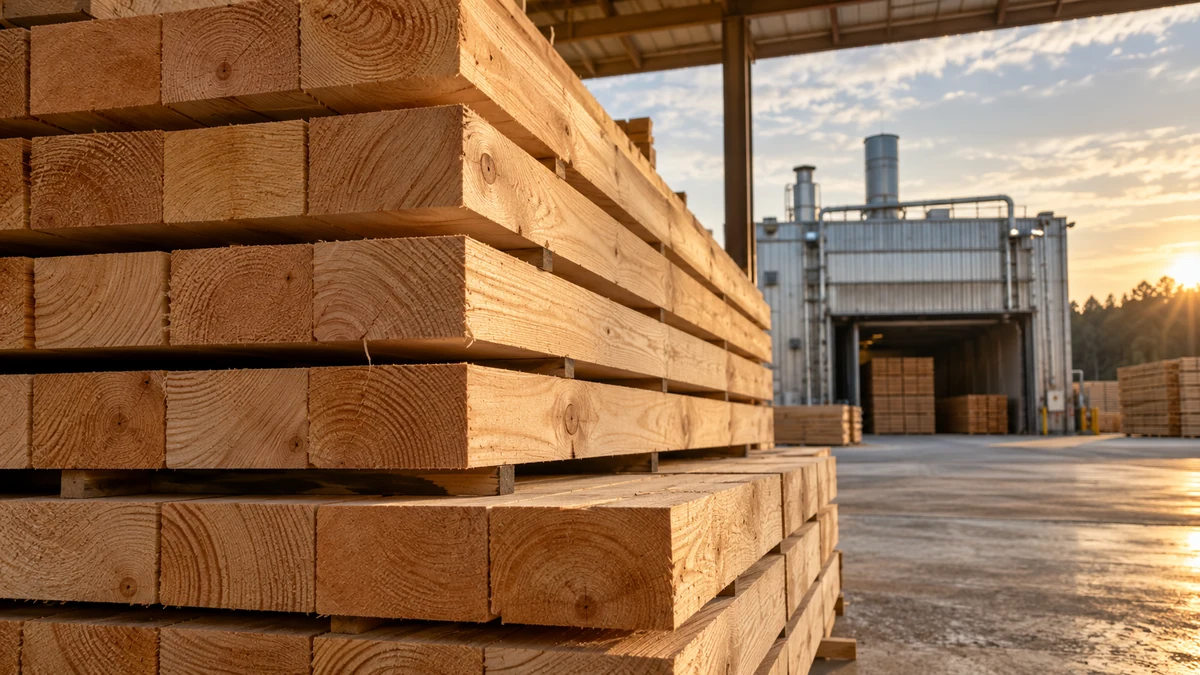
Interfor announced an indefinite curtailment of its sawmills in Meldrim, Georgia, and Summerville, South Carolina, on Aug 19, 2024. The two operations produced kiln-dried Southern Yellow Pine dimensional lumber and together had annual capacity of 330 million board feet. Persistent weakness in lumber markets was the company’s stated reason for the decision. Log deliveries were to be curtailed immediately, followed by an orderly wind-down that Interfor expected to finish by the end of the third quarter. The announcement affected two named manufacturing operations in the United States; the company did not give a fixed date for restarting either mill. Its description of the shutdowns as indefinite left their duration open.
Approximately 180 employees were affected across the two facilities. Interfor intended to offer work at other company operations where possible, with no commitment that every affected person would receive another position. Manufacturing Dive’s Aug 27, 2024 coverage identified 93 employees in Meldrim and 88 in Summerville from the two states’ Worker Adjustment and Retraining Notification postings. Those site figures total 181, while the company used an approximate combined figure. Rick Pozzebon, executive vice president and chief financial officer at the time, had described management’s focus on positioning Interfor through a period of supply rebalancing with demand during the Aug 9 earnings call. President and chief executive Ian Fillinger also identified continuing weak prices as a difficulty for the business.

Capacity and production guidance cover different periods
Interfor’s broader production plan was already changing before the two-mill announcement. On Aug 8, 2024, the company planned a temporary reduction of approximately 280 million to 350 million board feet between August and December. Management put that range at 15% to 18% of its normal operating stance and retained the option to adjust plans as market conditions changed. The expected production effect of Meldrim and Summerville during the remainder of 2024 was included in that guidance. The Aug 19 curtailment announcement also warned that the indefinite shutdowns were likely to affect output beyond 2024, based on circumstances known when management made the decision.
The combined 330-million-board-foot figure measured the mills’ annual capacity. The 280-million-to-350-million-board-foot range measured a planned reduction in company production over five months. Interfor did not announce a new combined reduction obtained by adding those two figures. Its company-wide annual lumber capacity was approximately 5.0 billion board feet in August 2024, across operations in Canada and the United States. The product description for the two affected mills was specific: kiln-dried Southern Yellow Pine dimensional lumber, used in building applications including wall and floor framing. The announcement did not assign the full corporate product range to either site, and it did not provide separate capacity figures for Meldrim and Summerville. The expected wind-down timetable concerned operations; it was not a schedule for an asset sale.

The earlier curtailments and Philomath disposal
Interfor had adjusted production repeatedly before August 2024. The earlier steps covered different periods and regions, rather than a single continuously measured reduction. In October 2022, the company announced an approximately 200-million-board-foot cut for the rest of that year and expected its normal operating schedule to resume in January 2023. A subsequent announcement covered at least 100 million board feet in the first quarter of 2023, concentrated largely outside the US South. In 2024, the changes included an Oregon mill as well as a temporary reduction across North American operations. The principal dated steps leading into the two Southern Yellow Pine curtailments were:
- February 2024: an indefinite curtailment at Philomath, Oregon, followed by approximately 100 job cuts identified in Interfor’s Feb 15 WARN letter.
- Apr 30, 2024: a planned 175-million-board-foot reduction between May and September across the company’s North American operating regions.
- Aug 8, 2024: temporary curtailment guidance of 280 million to 350 million board feet for August through December.
- Aug 19, 2024: the Meldrim and Summerville indefinite curtailments, with their remaining-2024 production effect already included in the August guidance.
Philomath’s property and assets were sold on Jun 27, 2024, for US$15.0 million in cash. Interfor recorded a C$4.3 million net non-cash charge with that disposal. The transaction therefore had a completed sale date and cash consideration, unlike the August announcement for Meldrim and Summerville. Interfor’s second-quarter production was also already affected by the April temporary curtailments and Philomath’s indefinite curtailment. The company produced 1,034 million board feet in the quarter ended Jun 30, compared with 1,069 million in the preceding quarter. Its total remained slightly above the 1,023 million board feet produced in the second quarter of 2023. The sequence combines a lower quarter-on-quarter output figure with a small year-on-year increase, using different comparison periods.

Regional output and lumber shipments in the second quarter
The US South produced 476 million board feet in the second quarter of 2024, compared with 480 million in the first quarter and 468 million a year earlier. Eastern Canada produced 276 million, against 288 million in the preceding quarter and 249 million in the second quarter of 2023. British Columbia contributed 158 million board feet, compared with 160 million quarter on quarter and 141 million year on year. The US Northwest produced 124 million, down from 141 million in the first quarter and 165 million a year earlier. Each regional figure covered the relevant operating region as a whole. Interfor did not divide the US South total into individual mill contributions in this quarterly highlights table.
Lumber sales reached 1,055 million board feet in the second quarter, exceeding the quarter’s production of 1,034 million. Sales had been 1,100 million board feet in the first quarter and 1,116 million in the second quarter of 2023. Fillinger described shipments running ahead of production and reductions in both log and lumber inventories, together with lower receivables. He also said log and conversion costs had fallen in most regions. Those were management’s descriptions of operating conditions; they did not supply an individual cost-per-board-foot figure for either affected Southern mill. Across the first six months of 2024, Interfor’s reported lumber production was 2,104 million board feet and sales were 2,155 million. The quarterly tables allowed for rounding differences between totals and individual figures.

Selling prices, benchmarks and revenue composition
Interfor’s average lumber selling price was C$602 per thousand board feet in the second quarter of 2024, compared with C$610 in the first quarter and C$649 a year earlier. The measure included freight and duties in gross sales. Its currency and scope differed from the benchmark lumber series presented alongside it. The Southern Yellow Pine composite benchmark was US$356 per thousand board feet, against US$383 in the preceding quarter and US$446 a year earlier. These company selling-price and benchmark observations were separate series. The company’s reported average covered its lumber sales, while the SYP benchmark referred to that product category and was denominated in US dollars. Neither figure was a quoted selling price for Meldrim or Summerville alone.
Total second-quarter sales were C$771.2 million. Lumber contributed C$634.8 million, while logs, residual products and other sales contributed C$136.4 million. In the previous quarter, total sales were C$813.2 million, including C$670.7 million from lumber and C$142.5 million from the remaining category. A year earlier, total second-quarter sales were C$871.8 million. The second-quarter results presented these figures in Canadian dollars and identified the interim financial information as unaudited. Interfor attributed lumber-market weakness to an imbalance between supply and demand, with elevated interest rates and continuing economic uncertainty weighing on demand. That explanation represented the company’s assessment of the market environment.

Loss measures and cash released from working capital
Interfor recorded a net loss of C$75.8 million in the second quarter of 2024, compared with C$72.9 million in the first quarter and C$14.1 million a year earlier. Its operating loss was C$63.3 million, and its adjusted EBITDA loss was C$16.7 million. Adjusted EBITDA had been a loss of C$22.3 million in the previous quarter and a positive C$41.9 million in the second quarter of 2023. Interfor classified adjusted EBITDA as a non-GAAP measure without a standardized meaning under IFRS and provided a reconciliation. The different loss figures therefore belonged to distinct accounting measures. The second-quarter EBITDA figure before the company’s further adjustments was a loss of C$28.2 million.
Operating cash flow was positive C$48.0 million in the second quarter, including a C$72.0 million release from operating working capital. The cash-flow movements included C$35.2 million from receivables and other balances and C$56.4 million from inventories. Prepayments absorbed C$8.2 million, while trade payables and provisions absorbed C$11.4 million. The company attributed the working-capital reduction partly to seasonal factors and partly to operating efficiencies it considered sustainable. Cash and cash equivalents ended the quarter at C$93.1 million, up from C$83.3 million at its beginning. Those cash balances and cash-flow movements covered the consolidated business. Interfor did not publish an allocation of the working-capital release between the Meldrim and Summerville operations.

Liquidity and the continuing capital programme
Available liquidity reached C$330.5 million at Jun 30, 2024, an improvement of C$30.8 million over the preceding quarter. The total combined cash with unused borrowing capacity after drawings and letters of credit. Interfor had a C$600.0 million revolving term line, with C$307.9 million drawn and C$54.7 million of outstanding letters of credit included in its use. Net debt was C$876.9 million, equivalent to 35.0% of invested capital, compared with 34.7% at the previous quarter-end. Interfor was in compliance with its financing covenants at Jun 30. Management believed, on the circumstances then known, that working capital and liquidity were sufficient for its foreseeable operating and capital requirements.
Capital spending continued alongside production curtailments. Interfor spent C$17.9 million in the second quarter, including C$6.6 million of discretionary investment directed mainly toward the multi-year rebuild of its Thomaston, Georgia, sawmill. Management reduced estimated full-year 2024 capital expenditure by C$20.0 million to approximately C$70.0 million after reviewing project returns against the weak lumber market. Outstanding capital-expenditure commitments for maintenance and discretionary projects totalled C$32.4 million at Jun 30. The company also expected approximately C$59.0 million of income-tax refunds during the second half of the year. That refund figure was an expectation at the August reporting date. The Thomaston spending related to a different Georgia operation from Meldrim and continued under its own investment programme.

A dated follow-up: third-quarter production and impairment
Interfor’s Nov 6, 2024 third-quarter results provided a later operating update. Production fell to 904 million board feet, 130 million below the second quarter, reflecting temporary curtailments that included the indefinite reductions at Meldrim and Summerville. The company recorded a C$17.3 million impairment against plant, equipment, intangibles and other assets associated with those curtailments. US South output was 443 million board feet, US Northwest output was 80 million, Eastern Canadian output was 216 million and British Columbian output was 165 million. Lumber sales totalled 951 million board feet. These figures covered the quarter ended Sep 30; the announcement’s publication in November did not change their reporting period.
The average lumber selling price declined to C$570 per thousand board feet in the third quarter, down C$32 from the second quarter. Total sales were C$692.7 million, comprising C$542.2 million of lumber sales and C$150.5 million from logs, residual products and other sales. The net loss reached C$105.7 million and the adjusted EBITDA loss reached C$22.0 million. The third-quarter results also included separate events affecting other operations, including the planned Quebec exit. The C$17.3 million curtailment impairment was specifically associated with the two Southern mills; it was separate from the C$73.8 million impairment linked to the Quebec sale plan. Neither accounting charge was presented as a cash payment to employees.

Cash collection and management’s market outlook
Interfor generated C$38.1 million of operating cash flow in the third quarter, primarily through C$55.6 million of income-tax refunds and a C$6.7 million working-capital reduction. It collected an additional C$12.6 million of refunds in October. Available liquidity rose to C$352.8 million at Sep 30, while net debt declined to C$849.9 million. Net debt nevertheless represented 36.1% of invested capital, against 35.0% at Jun 30. Capital spending was C$15.7 million in the quarter, including C$6.6 million of discretionary investment focused primarily on Thomaston. Management retained its approximately C$70.0 million capital-spending estimate for 2024 and set an approximately C$75.0 million estimate for 2025. Both full-year figures were guidance at the November announcement date.
Management expected near-term North American lumber markets to remain volatile in November 2024 as monetary policies changed and the industry adjusted production to demand. Its medium-term outlook remained more favourable, based on the age of the US housing stock, a housing shortage and demographic factors. Interfor expected supply growth to face limits from project completion and ramp-up schedules, labour availability and global fibre constraints. Those were company expectations rather than completed market outcomes. The business retained operations in both the United States and Canada, and management continued to describe flexibility over production, working capital and capital expenditure as part of its response. Its November operating update supplied quarterly outcomes without announcing a restart timetable for Meldrim or Summerville.
Leave a comment