
Clean TeQ’s Nyrstar project: wastewater design and delivery
Clean TeQ’s Nyrstar wastewater project moves from a design contract to delivery, using selective ion exchange and project-specific engineering.
A design contract with a separate delivery stage
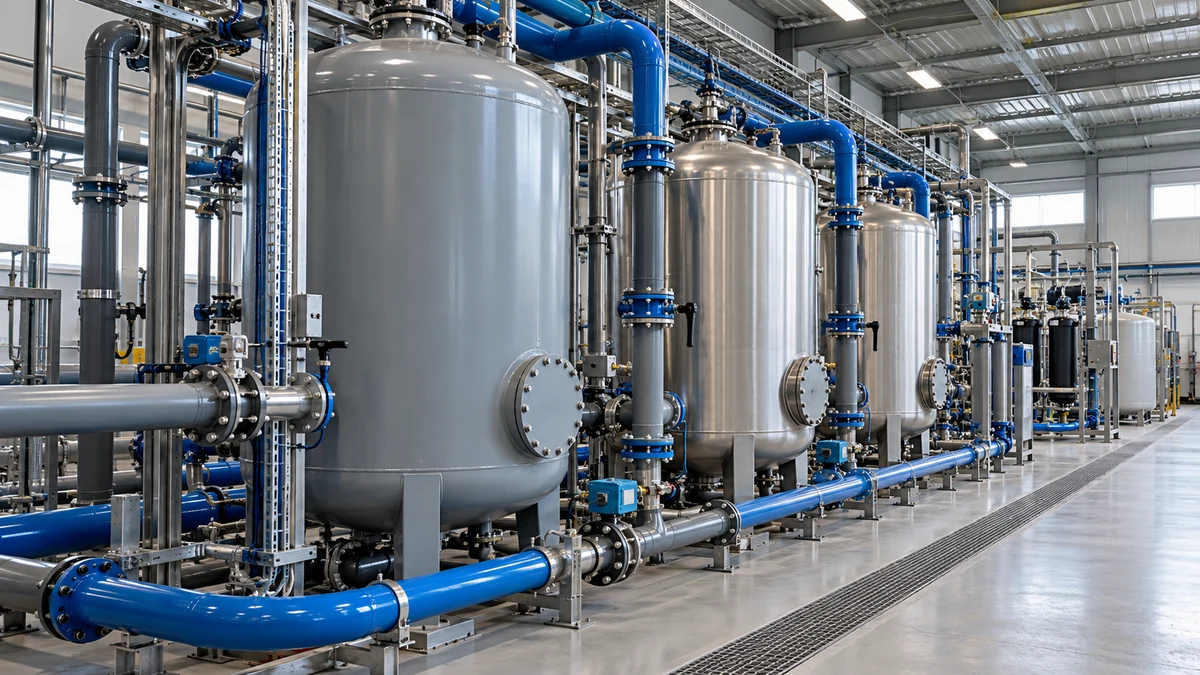
Clean TeQ Water secured an A$1.2 million assignment to design an industrial wastewater treatment plant for Nyrstar in Europe. The Melbourne-based company’s DESALX ion exchange process was selected after site trials in 2023–2024. The detailed engineering package was expected within 28 weeks of commencement. In May 2025, the next stage remained conditional on successful design work and agreement on commercial terms. Its estimated value was about A$9.4 million, covering procurement, fabrication and system integration. Neither party was then bound to proceed. The design agreement had no unusual termination provisions. The May 5, 2025 report therefore concerned an engineering award and a possible later delivery contract. Clean TeQ, headquartered in Australia, subsequently reported progress under separately dated project updates.
Clean TeQ announced the initial award on May 1, 2025. Its earlier qualification work at Nyrstar combined laboratory testing with pilot-scale operation during 2023 and 2024. The company described that work as validation of the process for the site’s wastewater and its proposed treatment requirements. Moving Bed Ion Exchange, or MBIX, provides the platform behind DESALX. It combines ion exchange chemistry with continuous operation, allowing treatment and resin reconditioning to form parts of an ongoing process. Clean TeQ presented selective contaminant removal, reduced chemical consumption and higher water recovery as benefits of its approach. Those are the supplier’s descriptions of its technology. The initial contract followed the qualification work and provided for detailed engineering; the company still anticipated a further agreement before equipment delivery. Laboratory tests, a pilot installation and a full-scale plant consequently occupy different stages in this project’s recorded development.
Progress during 2025 and the February 2026 award
In its July 31, 2025 update, Clean TeQ put completion of the Nyrstar design deliverables at 60%. Final delivery of the engineering package was then scheduled for early October. A hazard and operability study, commonly abbreviated HAZOP, had also been completed on site in Belgium. The update continued to describe procurement, fabrication and integration as a subsequent stage, dependent on completion of the design phase and commercial conditions. Its approximately A$9.4 million figure remained an estimate for that possible stage. The progress percentage referred to engineering deliverables. It did not describe construction completion, water recovery, contaminant removal efficiency or operating availability. The July update supplied an intermediate engineering milestone between the original award and the later execution agreement, while retaining the distinction between the contracted design work and equipment delivery.
On Feb 27, 2026, Clean TeQ announced the Phase 2 award for Nyrstar’s Balen operation. The filing identified a base contract of €5.06 million and €1.08 million of provisional services, giving a combined value of approximately €6.14 million, or about A$10.4 million. The provisional services remained subject to project requirements. The agreement followed completion of Phase 1 engineering, which had commenced in May 2025. The full-scale system is intended to remove sulphate and selenium from industrial process water. Major equipment deliveries were scheduled progressively through 2026 and early 2027, with installation, commissioning and completion to follow under the agreed schedule. The February 2026 filing records a delivery award with a provisional component and future milestones. It supplies the later development beyond the conditional position in May 2025.

The Balen industrial setting
Nyrstar’s Balen and Pelt operations sit in northeastern Belgium, approximately 80 km east of Antwerp and 18 km apart. Their production activities are integrated. Balen processes zinc concentrates and recycled secondary feed materials using roast, leach and electrolysis operations. Zinc cathodes from Balen and Auby travel to central melting and casting facilities at Pelt. Pelt also washes purchased oxide materials before their use in Nyrstar’s European smelters. Together, the operations produce special high grade zinc and alloys, including ZAMAK die-casting material. Balen additionally produces sulphuric acid, copper cement and a leach product containing lead and precious metals. Concentrates arrive by rail from Antwerp, while secondary zinc materials are delivered by truck. The wastewater project is located within this existing metals-processing business. Its 2026 delivery announcement specifically identifies Balen; the initial 2025 design coverage referred more broadly to one of Nyrstar’s European operations.
Two selective ion exchange stages
DESALX uses two MBIX modules in series. The first removes multivalent positively charged ions, including calcium, magnesium and other metals. The second removes multivalent negatively charged ions, including sulphate. Monovalent sodium and chloride ions can pass through the process. This selective treatment differs from removing every dissolved salt from the water. Each module contains a treatment column and additional columns that recondition its ion exchange resin. Clean TeQ describes a moving packed resin bed that can also retain suspended solids when required. The process is designed to tolerate solids in the incoming water and precipitates, such as gypsum, forming during desorption. Its gypsum-bearing stream can be treated in an existing lime precipitation system. Where that equipment is absent, the supplier proposes combining DESALX with a high-density sludge clarifier. The resulting solid-waste route is part of the company’s proposed zero liquid discharge configurations.
Continuous Ionic Filtration, marketed as CIF, provides another description of Clean TeQ’s moving-bed approach. Water flows upward through a packed bed of charged resin beads and leaves from the top of the adsorption column. Resin leaves the bottom, moves through reconditioning columns and returns to the treatment stage. The countercurrent movement brings water and resin into contact while allowing resin circulation. Physical filtration can accompany removal of dissolved ionic species when the feed requires it. Commercially available resins can be selected for the contaminants being targeted. Clean TeQ lists applications involving hardness, metals, nitrate, phosphate, boron and sulphate. The technology is used across different treatment configurations, rather than with one universal resin for every contaminant. For the Nyrstar project, DESALX is the named application built on the MBIX platform. The general CIF description explains resin circulation; it does not specify Balen’s final equipment arrangement or operating parameters.
Hardness treatment is one application of the ion exchange platform. Calcium and magnesium are the ions most commonly associated with hard water. They can contribute to scaling in pipes, boilers, turbines and heat exchangers, while process-water chemistry may also affect industrial operations. Clean TeQ’s hardness-removal configuration uses resin washing and regeneration across a series of four columns. The packed resin bed can remove suspended solids as well as exchanging dissolved ions. The company offers flowsheets for very hard water above 4,000 mg/L expressed as calcium carbonate, as well as selective treatment of streams intended for reuse. It also supplies conventional batch ion exchange, which may require solids pretreatment and hydrochloric acid regeneration and can be economical at smaller flow rates. These are application-dependent options in the supplier’s offering. The published hardness threshold is a general design capability, rather than a disclosed measurement of Nyrstar’s wastewater.

Sulphate treatment and resin selection
Sulphate treatment can follow several flowsheets within Clean TeQ’s portfolio. Sulphate occurs naturally in groundwater and can also occur at high concentrations in industrial and mining wastewater where sulphuric acid is used. The supplier offers selective removal for processing streams, with gypsum-based solids as a possible waste form. In some applications it combines continuous ion exchange with nanofiltration or reverse osmosis. Its HIROX configuration can use membrane brine to regenerate the upstream ion exchange stage. DESALX instead provides a membrane-free option for selective treatment of multivalent ions. The choice depends on the water and the required product or discharge conditions. A gypsum solids route, membrane brine management and recovery of reusable process water are separate parts of the company’s treatment offering. Their availability as options does not mean that all of them form part of the Nyrstar installation.
Resin selection determines which dissolved species an ion exchange system targets. Clean TeQ works with resin manufacturers in Europe, Asia and North America and also develops formulations for specific applications. Its selection criteria include loading capacity, selectivity, particle size distribution, resistance to fouling and hydro-mechanical strength. Those properties vary between products even within the same functional class. The supplier can test resins, adjust flowsheets and work with manufacturers when standard products do not meet a process requirement. Its published resin categories include strong and weak acid cation resins, strong and weak base anion resins, and chelating resins. Chelating materials provide a more targeted route for particular metal ions; the company gives copper scavenging and scandium recovery as examples from its wider applications. The classifications describe a selection toolkit. The Nyrstar contract announcement does not identify a particular commercial resin grade.

- Cation resins exchange positively charged species.
- Anion resins exchange negatively charged species.
- Chelating resins target selected metal ions.
Designing for a specific wastewater stream
Clean TeQ’s customised ion exchange plants are designed around feed-water quality, flow rate and the customer’s treatment requirements. Its engineering choices include vessel size, construction materials, resin, reagents and regeneration schedules. Integration with existing site equipment is also part of the design. The company offers conventional fixed-bed systems alongside continuous configurations when the latter suit the application. Resin can therefore be used within different vessel and operating arrangements. The engineering service combines selection of the treatment medium with the equipment and flowsheet needed to use it. Clean TeQ identifies durability, chemical consumption, waste production and treated-water targets as factors considered during design. These are the variables addressed by its general plant-design service. For Nyrstar, the separately contracted engineering phase followed site trials and preceded the execution agreement. The public design-stage progress record gives milestones, without supplying a complete plant equipment schedule or feed-water specification.
Clean TeQ’s project quality system includes a project-specific quality, health, safety and environment management plan. The project manager adapts the plan to the customer’s specifications, programme and requirements. Engineering decisions use calculations and supporting information from research, pilots and engineering references. Design reviews and HAZOP studies involve the customer and design engineers, with resulting changes incorporated into revised documents. Deliverables pass through checks by discipline leads, the technology manager and project manager before submission. Document control is intended to keep superseded versions out of construction and decision-making. Equipment inspection and test plans cover procurement through delivery and final checks. Vendors submit plans for approval before fabrication, and inspectors check work at agreed hold points. These procedures describe the company’s project-management framework. The July 2025 Nyrstar update separately confirms that an on-site HAZOP had taken place for that particular design assignment.
Procurement, commissioning and support
Under Clean TeQ’s engineering, procurement and construction service, the project manager and project engineer oversee procurement and delivery. The company models plants in CAD software and usually pilots the process before the main procurement and construction work. It has sourcing staff in Australia and China, and procured equipment is inspected and tested under the quality plan. During construction, the project manager attends the site to oversee installation and address issues. Clean TeQ presents these activities as its normal delivery service.
Commissioning normally involves design engineers, the construction team and site personnel. Clean TeQ trains operators in the process, operation and maintenance, and describes a usual on-site performance period of at least 30 days. Its support offering can include periodic visits or remote review where access to the plant’s supervisory control and data acquisition system is available. A local representative may also be stationed at a plant for an extended period. These are general service arrangements; the February 2026 Nyrstar filing scheduled installation and commissioning after equipment delivery. It did not announce that the Balen plant had already entered operation.

Industrial reuse within the broader offering
Industrial customers use Clean TeQ’s systems for process-water preparation, reuse, brine management and treatment before discharge. The company’s portfolio includes targeted removal of calcium, sulphate, organic contaminants and metals. Other flowsheets combine high-recovery reverse osmosis with evaporation or biological treatment for different water streams. Its EVAPX evaporation system uses flat-plate heat exchangers and can use available waste heat. BIOCLENS and BIONEX address ammonia and nitrate in applications separate from the named Nyrstar DESALX project. The wider portfolio gives the supplier several treatment routes for different customers and contaminant mixtures. At Balen, the contracted full-scale project is specifically described as sulphate and selenium removal using the MBIX-based DESALX system. That stated scope remains distinct from the broader list of technologies the company offers for industrial water treatment.
Peter Voigt, Clean TeQ’s chief executive, linked the Nyrstar assignment to selective treatment and recovery of useful by-products where feasible. His comments express the company’s intended resource-recovery approach. The project’s dated records separately identify testing, detailed engineering and the later delivery award.

Leave a comment