
Capral’s Queensland recycling loop: scrap, billet and extrusion
Capral’s Queensland recycling project connects extrusion scrap, metal sorting and Boyne billet production, alongside product-specific environmental evidence.
A Queensland route back to extrusion
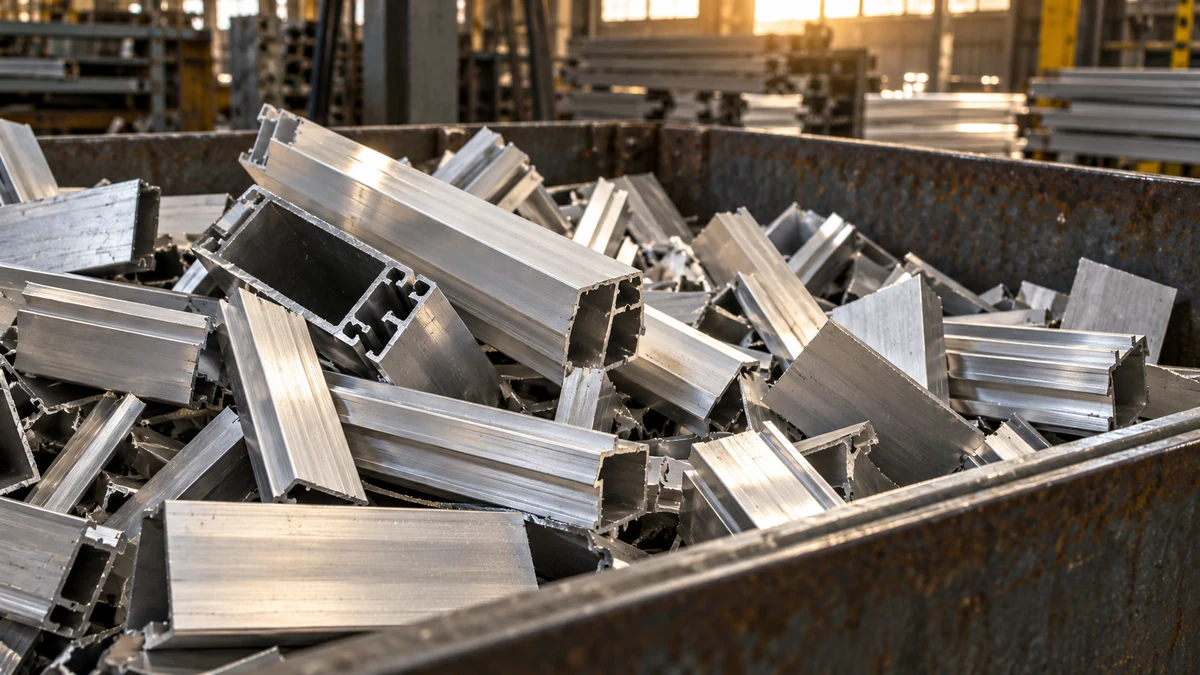
Capral, Sims Metal and Rio Tinto are working on a domestic recycling route for aluminium left over from extrusion production. Their July 2025 initiative calls for Capral’s post-production scrap to be processed locally and returned as new billet for its extrusion operations. The announced batch is 1,000 tonnes of billet containing at least 20% recycled material. Sims Metal sorts and processes the scrap before Rio Tinto’s Boyne Smelter remelts it. Capral then receives the billet for further manufacturing. Tony Dragicevich, Capral’s managing director and chief executive, described the collaboration as a practical way to increase recycled content and reduce the company’s carbon emissions. The July 2025 announcement followed a smaller trial in 2024. The 1,000-tonne figure is the planned billet output of the new project; the earlier trial’s scrap tonnage measures an input.
The partners allocate different jobs to each part of the loop. Capral supplies material from its operations, Sims prepares a consistent scrap stream and Boyne carries out remelting and billet casting. David Burrows, Sims Metal’s chief commercial officer, linked greater recycled content to industrial decarbonisation and stronger domestic supply chains. Armando Torres, Rio Tinto’s Pacific Operations Aluminium managing director, emphasised the technical teams’ work and the customer demand behind the project. Capral places the chain within Queensland, connecting bauxite mining, alumina refining, smelting, extrusion and remelting in the same state. The company also expects local processing to reduce transport-related emissions. That expectation accompanies a defined material route; the launch did not provide a measured project-specific transport saving or lifecycle emissions result. The new batch was announced as material to be produced and supplied back to Capral, rather than as a completed delivery.

The trial and the smelter
Capral’s original trial announcement, dated Nov 13, 2024, describes between 50 and 100 tonnes of post-production scrap from its Bremer Park extrusion plant in southeast Queensland. Boyne remelted the scrap and cast billet with a minimum recycled content of 20%. The July 2025 retrospective uses 100 tonnes when referring to that trial. Both accounts identify Bremer Park as the source and the same minimum content in the resulting billet. In November, Capral was still exploring how to incorporate this material into its product offer. Luke Hawkins, divisional general manager of Industrial Solutions and Supply, explained that the company already recycled most of its scrap, but generally sent it overseas, where it often became different products. He wanted local recycling to become available more broadly. His comments concerned a procurement objective and the trial’s potential, rather than a commitment that every Capral extrusion would contain recycled aluminium.
Boyne Smelters Limited operates at Boyne Island in Queensland. The smelter began operating in 1982 and is connected by conveyor to Queensland Alumina Limited’s refinery, which supplies the alumina used in primary metal production. Rio Tinto’s current operation profile identifies BSL as a joint venture: Rio Tinto holds 73.5%, YKK Aluminium 9.50%, UACJ Australia 9.29% and Southern Cross Aluminium 7.71%. The plant’s stated annual aluminium capacity has grown from 210,000 tonnes at its opening to more than 500,000 tonnes after successive investments. Those are whole-smelter annual capacity figures, separate from the recycling initiative’s 1,000-tonne billet batch. The project uses an existing smelting and casting operation with its own primary-metal supply chain. Boyne’s broader production capacity does not specify the amount of outside scrap it can accept or establish a new dedicated recycling plant.

Which scrap enters the loop
Aluminium scrap comes from manufacturing operations as well as products that have reached the end of their working lives. The Australian Aluminium Council distinguishes three broad streams. Pre-consumer material includes sheet and extrusion offcuts produced during manufacturing and fabrication; its known composition can make some of it suitable for a primary smelter. Post-consumer material has already been used and discarded, such as window frames, beverage cans, electrical cables and automotive cylinder heads. Its composition may be uncertain and it can contain contamination, which limits acceptance by primary smelters. The council also treats pre-consumer material remelted within the company where it was generated as internal scrap. These distinctions keep the Queensland project’s production offcuts separate from the much wider collection of used aluminium goods. The council’s general energy comparison puts remelting at about 5% of primary production’s energy requirement. That industry comparison does not measure the energy balance of Capral’s specific billet batch.
- Pre-consumer scrap arises before the finished product reaches its user.
- Post-consumer scrap comes from products discarded after use.
- Internal scrap is remelted within the company that generated it.
Capral’s domestic experiments predate the Boyne collaboration. A March 2026 study by L.E.K. Consulting for the Australian Aluminium Council records a 2022 pilot with Tomago Aluminium that demonstrated domestic remelting of extrusion scrap. Logistics and planning constraints limited its commercial expansion. The later Boyne route combines clean extrusion scrap, Sims processing and remelting into billet returned to the extruder. The same study discusses extending such systems to end-of-life windows, doors and façades, subject to suitable sorting and alloy separation. It also identifies G.James Aluminium Products and Alspex Extrusions alongside Capral in the wider emerging programme. The 2026 industry study is retrospective context for the initiative. Its discussion of future post-consumer recovery concerns a possible extension, while the announced Capral batch starts with scrap from production. Collecting used building components and preparing known extrusion offcuts remain different tasks.
From billet to customer profiles
Capral turns billet into standard geometric shapes and sections designed for particular customers. Its current manufacturing capability includes extrusion facilities in Queensland, Victoria, New South Wales, South Australia and Western Australia. The Queensland operation at Bundamba includes Bremer Park, the source of the trial scrap. Capral’s capability table lists three Bremer presses with different log diameters and profile limits. The B1 and B4 presses use 203 mm logs; B3 uses 178 mm logs. Their listed customer saw lengths run from 3.0 to 7.2 metres, with shorter lengths referred to the mill. The listed alloys vary by press, including 6060 and 6106, with 6063 on B3 and B4 and 6005A on B4. Alloy, temper and dimensions form part of the product specification. The table describes manufacturing capabilities, rather than a declaration that every listed alloy or profile was included in the recycled-content trial.
Custom extrusion design gives Capral’s customers a way to incorporate fabrication and assembly features directly into a section. The company’s design service combines technical information with in-house support for developing customer-specific profiles. Capral identifies manufacturing efficiency, product differentiation and required engineering performance as reasons for choosing a custom section. Features may serve visual, structural or fabrication purposes, depending on the application. Jared Silcox, a designer at playground manufacturer WillPlay, describes six custom Capral extrusions with different roles in the company’s playground systems. His example includes side features that simplify drilling and assembly. That is a named customer’s account of profile design and installation, rather than a test of the recycling project. Capral also specifies that alloy and temper should be chosen for the properties required in production. Recycled billet enters this existing manufacturing activity, where customers still order a particular section for a defined use.

Further processing takes place after extrusion. Capral provides machining and processing at Bremer Park, Campbellfield and Canning Vale, supported by independent contractors for bespoke requirements. Its services include angled cuts, milling, drilling, punching, routing, bending and edge deburring. Customers can receive individual components or prepared kits. Capral describes nesting parts on sheet and plate as a way to reduce waste, while its CNC machining centres at Campbellfield and Bremer Park prepare semi-fabricated extrusions for further assembly. Suitable profiles must be rigid enough to remain clamped during machining; smaller sections may need sample testing before a quotation. These operations produce specified components from the extruded material and provide another manufacturing setting in which cut pieces and offcuts arise. The service description covers Capral’s processing offer; it does not assign a scrap recovery rate, machining yield or guaranteed waste reduction to the closed-loop billet batch.
Lower-carbon products and their documentation
Capral’s current LocAl and LocAl SG ranges offer a separate set of product and sourcing information alongside its recycling work. The company describes these as lower-carbon aluminium extrusions manufactured in Australia using responsibly sourced primary aluminium. Both streams use a mass balance chain of custody system that Capral identifies as aligned with ISO 22095. The current product page also describes ASI-certified supply chains, published Environmental Product Declarations and technical support for customers choosing materials. Its available support includes EPD documentation, embodied-carbon discussions, specification wording and certification information. Declare labels are available for selected Building Systems products. These descriptions identify several forms of product information with different scopes. A lower-carbon primary-metal offer, a recycled-content percentage and a chain of custody system describe different characteristics. The Queensland project’s minimum 20% recycled content is a property of the announced billet, rather than a universal description of the LocAl ranges.

Capral announced product-specific Environmental Product Declarations for LocAl and LocAl SG on Jul 14, 2026. The company had introduced the LocAl brand in 2022 and presented the declarations as an additional layer of independently verified environmental information. Marketing manager Kellie Moore connected the release to customers’ requests for documented data for specifications and embodied-carbon reporting. She described a shift toward more precise environmental information across construction and manufacturing. Capral identified ISO 14025 and EN 15804 as the declaration standards and The International EPD System as the publication programme. Its announcement highlighted the cradle-to-gate A1–A3 impacts. The declarations and their detailed product definitions provide the relevant scope for individual data, rather than the brand announcement alone. Moore’s comments express Capral’s view of customer requirements; the publication of an EPD does not itself record completion of the Queensland recycling batch or measure that project’s performance.
EPD Australasia lists two separate records: EPD-IES-0031050:001 for LocAl and EPD-IES-0032247:001 for LocAl SG. The listed first-version dates are Apr 28, 2026 and Jun 12, 2026 respectively. Both are product-specific declarations, with Claudia A. Peña identified as verifier. The database gives Australia as the geographical scope and identifies Construction Products PCR 2019:14, version 2.0.1. It also lists compliance with EN 15804+A2:2019/AC:2021. The declared product basis is one kilogram of extruded material. Separate registration numbers keep the two product streams identifiable when customers obtain their environmental information. The database directs users to each individual declaration for its registration, version and expiry details. These are 2026 documentation records, later than the recycling announcement. Their existence provides a way to identify the products and assessment records, while the individual documents contain the manufacturing and modelling assumptions.

The LocAl declaration defines a particular mill-finish product, LocAl–AB, extruded at Bremer Park from primary billet sourced from Aluminium Bahrain. Its declared unit includes one kilogram of profile and its packaging, using production data for Jan 1–Dec 31, 2024. The assessment includes A1–A3, packaging end-of-life in A5, product end-of-life modules C1–C4 and recovery potential in module D. Transport to the construction site and use-stage modules are excluded. The model sends manufacturing scrap overseas for remelting. These boundaries describe a different material stream and reference period from the announced Queensland recycling route. The company’s launch announcement highlighted cradle-to-gate information, while this declaration includes additional selected lifecycle modules. Its environmental results therefore need the document’s product definition and boundaries attached. They cannot be transferred directly to the Boyne recycled-content billet batch.
Certification across the material chain
Capral’s ASI certifications address another part of its operations. On Jul 23, 2026, the company announced renewed certification against the Aluminium Stewardship Initiative Performance Standard and Chain of Custody Standard. Capral joined ASI in June 2022 and first achieved certification against both standards on Jun 2, 2023. A surveillance audit and scope extension followed in late 2024, before the recertification audit conducted between Apr 20 and May 19, 2026. The renewed period runs from Jun 2, 2026 to Jun 1, 2029. Group ESG and risk manager Marc Banks described an examination of records, systems and operational practices across the business. The Performance Standard covers environmental, social and governance requirements, while Chain of Custody addresses controlled material flows. Capral describes documented mass balance accounting for eligible ASI material. These certifications accompany its product documentation and recycling work, each with its own assessment subject and dates.

ASI’s own membership record identifies Performance Standard certificate 287 Rev. 2 and Chain of Custody certificate 288 Rev. 2, both for the Jun 2, 2026–Jun 1, 2029 period. The scope covers extrusion, warehousing and distribution of aluminium products and services at named Australian operations, including Bremer Park and its regional distribution centre. The performance audit lists semi-fabrication and material conversion as supply-chain activities; the custody audit lists post-casthouse activity. The registry also notes that listed value-chain activities can include certified and non-certified operations. Its scope and certificate details specify the audited organisation and activities. The Queensland recycling initiative has a more specific material route: production scrap prepared by Sims, remelted at Boyne and supplied back to Capral as billet. Its announced quantity and recycled-content threshold remain the project’s stated production parameters, alongside the separate documentation for products, manufacturing capabilities and responsible material accounting.
Leave a comment