
Blue Diamond’s manufacturing transition and almond ingredient portfolio
Blue Diamond’s planned manufacturing transfer, the roles of its Central Valley plants and the almond ingredients supplied by its grower-owned cooperative.
A manufacturing transfer within California
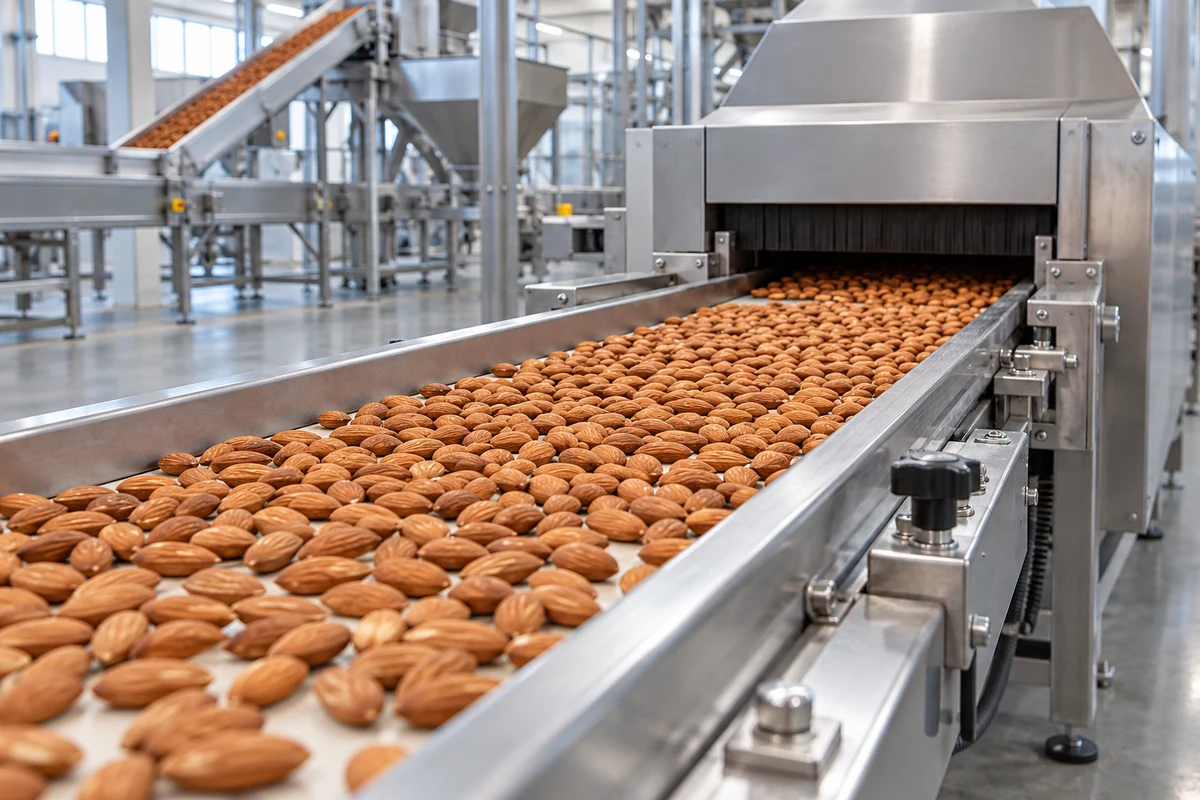
Blue Diamond Growers planned to move most manufacturing work from its historic midtown Sacramento almond plant to its existing Turlock and Salida facilities. The cooperative intended to keep its headquarters in Sacramento. President and chief executive Kai Bockmann attributed the decision to the expense and inefficiency of operating the older buildings. The transfer was scheduled to proceed in stages over 18 to 24 months, with roughly 10% of plant employees expected to leave during the initial year. About 600 employees would be affected overall. Blue Diamond offered retention incentives, severance and help finding subsequent employment, alongside opportunities for some employees to work elsewhere in the organization. The Sacramento manufacturing transition was still a plan when the news was published on Jun 25, 2025.
The cooperative had announced its decision on Jun 6, 2025, when Bockmann met with the Sacramento plant team. Blue Diamond expected most affected employees to remain beyond that first year and said it would devote time and resources to assisting them. The company intended to exit and sell the historic plant site, which covered more than 50 acres near downtown Sacramento. Moving processing to the Central Valley would place those operations near many of the cooperative’s farmer-owners. Blue Diamond represented nearly 3,000 California almond growers and had been established in 1910. Its business combined almonds sold under consumer brands with ingredients supplied to other food companies. The manufacturing transfer concerned the processing network within California, rather than a move of the cooperative’s corporate office out of its home city.
The later agreement for the Sacramento campus
On May 19, 2026, Blue Diamond selected Sacramento-based Bardis & Miry Development, LLC to acquire approximately 35 acres of the midtown campus. The initial concept involved 1,000 to 2,000 homes, shops at ground level and community amenities. Katherine Bardis-Miry and Bay Miry brought experience in residential projects, historical infill and urban redevelopment. At the announcement, the developer was carrying out due diligence, with design, project phases and community engagement still to be developed. Bay Miry emphasized that the project remained preliminary and that redevelopment options were open. The planned housing and commercial uses therefore remained proposals rather than completed buildings on the former manufacturing property.
Blue Diamond secured a three-year leaseback intended to keep its corporate headquarters on the campus until at least April 2030. It also planned to retain about 19 acres for inshell almond processing, while maintaining its headquarters in Sacramento. Ken Turton of Turton Commercial Real Estate represented the cooperative in the transaction. The campus redevelopment arrangement concerned a portion of the property and included continuing cooperative uses alongside the proposed new neighborhood. The selection of a developer in 2026 was a later step than the manufacturing decision announced in June 2025.

Turlock’s established processing operations
The Turlock plant opened in 2013 with 35 employees. By its tenth-anniversary celebration in June 2023, its workforce had reached 162. Food Engineering named it Plant of the Year in 2014. In 2015, Blue Diamond expanded the plant’s almond flour line and brought its Integrated Beverage Base Line fully into operation; that line supported Almond Breeze production. The facility’s development already included ingredient processing and beverage-related operations well before the Sacramento transfer was announced. Turlock’s anniversary celebration brought local community leaders to the plant to recognize its employees and the cooperative’s development over the preceding decade.
Blue Diamond recorded 99% scores in Turlock’s food safety and quality audits in both 2022 and 2023. The cooperative also identified the site’s June 2021 recognition through the Modesto Chamber of Commerce’s California Green Business Network, following the Salida site’s recognition two months earlier. Travis Hill was Turlock’s site director at the 2023 anniversary. Employees from Turlock and Salida participated in local volunteer events, including work to remove rubbish and repair fences and buildings. These milestones belong to the receiving plants’ earlier operating history; the workforce and audit figures refer to their stated years.

Receiving almonds and renewing equipment
Salida performs both receiving and processing functions. Blue Diamond gives its receiving station a throughput of more than five million pounds a day, while identifying a separate brown-almond processing line capable of handling up to 1.2 million pounds in 24 hours. Receiving volume and processing-line capacity describe different operations. The site’s brown-almond pasteurization uses controlled temperature and humidity. Its activities also include extra-fine blanched almond flour. The cooperative links continuing plant work to removing foreign material and insect-damaged almonds, alongside employee safety, food safety and reductions in energy use and emissions. These functions form part of its California processing network in the United States.
Blue Diamond’s 2024 equipment programme included electronic sorting machines at Sacramento and wastewater-treatment equipment at Turlock. The cooperative associated the Sacramento machines with grading and processing efficiency and the Turlock installation with lower costs and improved performance. Teams also adjusted warehouse cooling controls and addressed compressed-air inefficiencies. Work on planning, transportation and the domestic third-party warehouse network aimed to bring distribution arrangements into closer alignment with customer locations. These were specific operational initiatives preceding the June 2025 transfer announcement. The cooperative described improvements in delivery performance and customer complaints, without publishing numerical savings for those individual projects in that account.

Grower representation and payment arrangements
Blue Diamond’s board has between nine and eleven directors. Nine district directors represent the cooperative’s nine California grower districts, with members voting for their district representatives. District terms last three years, and three expire each year. The district directors may appoint up to two directors-at-large for one-year terms. Management does not hold board seats. After the annual meeting, the board elects its chair and vice-chair and addresses organizational business. District liaison committees also connect growers with management and the board; their members serve three-year terms and meet at least twice annually.
The standard grower payment programme includes a payment after harvest delivery, progress payments in January, April and June, and a final payment in September. Accelerated payments draw on estimates of future amounts and are recovered from the next available regular payment. Growers can also defer payments and earn interest, while stockpile advances precede delivery and depend on estimated kernel weight. Quality premiums take account of rejected material, foreign matter and chipped or broken almonds. A long-term crop agency agreement provides membership, ownership and voting rights. Five-year non-member agreements and tonnage contracts carry limited rights. These programmes may change with market conditions, the economy and decisions by the board.

An ingredient range beyond packaged snacks
Blue Diamond’s wholesale business supplies whole and inshell almonds, cut forms, butter, flour and oil. Its customers include food and beverage manufacturers, foodservice operators, international retailers, distributors and wholesalers. Applications extend from baked foods, snack bars and confectionery to dairy alternatives. Sweet almond oil also serves personal-care and cosmetics businesses. Packaging varies with the product and includes cartons, bulk sacks, fibre bins, drums and intermediate bulk containers. The almond ingredient portfolio spans both intact nuts and ingredients produced through cutting, grinding or oil extraction. Individual product specifications set out the available forms and handling arrangements.
Whole almonds are offered as brown kernels as well as dry-roasted, oil-roasted, blanched and flavored products. Nonpareil has a medium-sized, flat kernel with a smooth surface and a mild, sweet flavor. Independence has a similar profile with a slightly wrinkled surface. Monterey, grouped with Carmel-type almonds, has a longer, narrower shape and is offered in larger sizes for ingredient uses. Butte almonds are smaller and rounder, with a wrinkled surface; Blue Diamond identifies their suitability for blanching and flavoring. Its broader California Types group includes a wider range of shapes and colors. The variety table is representative, with availability requiring confirmation. Whole-almond packaging includes 25- and 50-pound cartons and 2,200-pound fibre bins or bulk sacks. The cooperative lists cool, dry, odor-free storage away from sunlight, with temperatures of 35–45°F and humidity of 55–65%.
Cut almonds and flour specifications
Cut forms include split, sliced, slivered and diced almonds. Natural and dry-roasted versions retain their skins, while blanching removes the skins through scalding and produces a lighter-colored ingredient. Sliced almonds are available in extra-thin, thin, regular and thick forms; slivered products have regular and medium options. Diced almonds have small, medium and large options based on US screens. The catalogue lists dry-roasted, blanched and flavored splits; natural or blanched slivers; and multiple treatments for slices and diced forms. These combinations are not identical across every shape. Suggested applications include cereals, bars and yogurt, as well as baked products and confectionery. Packages range from cartons to fibre bins and bulk sacks carrying 1,000 to 2,200 pounds.
The flour range distinguishes natural from blanched ingredients and fine from extra-fine granulation. Fine Natural and Extra Fine Natural flour retain the light tan color associated with almond skins, with fine and powdery textures respectively. Blue Diamond lists breading, crackers, bars and muffins among their uses. Fine Blanched and Extra Fine Blanched products have an ivory color, again with fine or powdery texture. Their listed applications include baked foods, bars, soft desserts and sauces. The manufacturer offers 25-pound cartons and fibre bins beginning at 1,250 pounds. Its specifications also provide storage conditions and allow customers to request detailed product information. These four flour forms give food manufacturers choices in color and particle texture within the same almond ingredient family, without treating all milled almonds as one uniform specification.

Butter, oil and almonds in the shell
Almond butter is supplied in Natural, Blanched and Blanched Lightly Roasted forms. Blue Diamond associates the Natural version with the darkest color and strongest nut flavor, and lists confectionery and baked foods such as cookies and soft-baked bars as applications. The Blanched version has a lighter color and flavor, with uses in baking and nutrition shakes. Blanched Lightly Roasted butter has the lightest profile in the comparison and is offered for dairy alternatives and shakes. The business can adjust flavor and coarseness for customer formulations. Available containers include 45-pound pails, 500-pound drums and 2,200-pound intermediate bulk containers. These are wholesale ingredient packages for further manufacturing, alongside the cooperative’s separate consumer-branded range. The product’s color, flavor and coarseness remain distinct formulation characteristics.
Blue Diamond presses its oil from shelled California almonds and uses physical refining followed by purification with vacuum and steam. Its applications extend to foods and personal care. The manufacturer identifies compatibility with other oils and the ability to remain liquid at refrigerated temperatures among its functional properties. Food applications include snack and nutrition bars and baking. Personal-care applications include emulsions and massage oils. The available packaging ranges from 35-pound jugs-in-boxes and 420-pound drums to totes and bulk transport, including a 45,000-pound flexitanker. The oil’s processing route and liquid handling formats differ from the cartons and bins used for kernels and flour. Blue Diamond offers full specifications to customers seeking detailed ingredient information.

Inshell almonds retain their natural protective shells for subsequent local processing or direct sale to consumers who crack them. The cooperative lists Nonpareil and Independence varieties in this form, both with soft shells, a light color and a pronounced suture opening. The nuts are medium-sized and flat in shape. Its catalogue distinguishes photographs of the inshell nut from the corresponding kernel, rather than presenting them as interchangeable products. A listed wholesale package holds 50 pounds. The product remains part of the cooperative’s portfolio alongside shelled and manufactured forms. Its continuing presence also connects with the approximately 19 acres Blue Diamond planned to retain for inshell processing under the later Sacramento campus arrangement.
Handling ingredients and developing consumer products
Blue Diamond’s ingredient handling guidance stresses protection from direct sunlight, moisture and strong odors. Shelled almonds can darken under prolonged sunlight, while almonds can absorb odors from nearby chemicals, foods or other materials. The cooperative recommends stock rotation and cool, dry storage to maintain flavor and stability. Freezing can extend storage life, provided packaging protects the almonds against ice formation and moisture. Packaging is particularly important for roasted products. Blue Diamond also identifies an on-site quality laboratory accredited for aflatoxin analysis and the use of processing measures addressing skin flaking and texture. Those quality-control activities sit alongside the different storage and packaging specifications for individual product forms.
On Feb 13, 2026, Blue Diamond introduced a new branded almondmilk line in 48-ounce bottles. Unsweetened Simple contains water, almonds and sea salt. Sweetened Simple adds cane sugar, giving it four ingredients. Signature Creamy was developed for a richer texture, while Chocolate Protein was announced with eight grams of plant protein. Maya Erwin, group marketing manager for innovation, associated the launch with customers’ interest in almond flavor and a creamier product. Suggested uses included cereal, smoothies, overnight oats and drinks such as iced coffee or matcha. This 2026 launch followed the manufacturing-transfer announcement and joined an established business that already supplied Almond Breeze and multiple wholesale almond ingredients.
- Whole and inshell almonds retain the nut as the central product, with different degrees of shell removal and treatment.
- Split, sliced, slivered and diced forms provide specified shapes for manufactured foods.
- Natural and blanched flours combine different colors with fine or extra-fine textures.
- Butter grades provide different flavor, color and coarseness options for customer formulations.
- Almond oil uses pressing and physical refining and serves food and personal-care applications.
Leave a comment