
India’s forged-wheel programme: contract, factory and machining system
A twenty-year Indian railway-wheel contract links a Chennai factory, an automated machining system and the manufacturing businesses of Ramkrishna and Titagarh.
A domestic supply programme for forged wheels
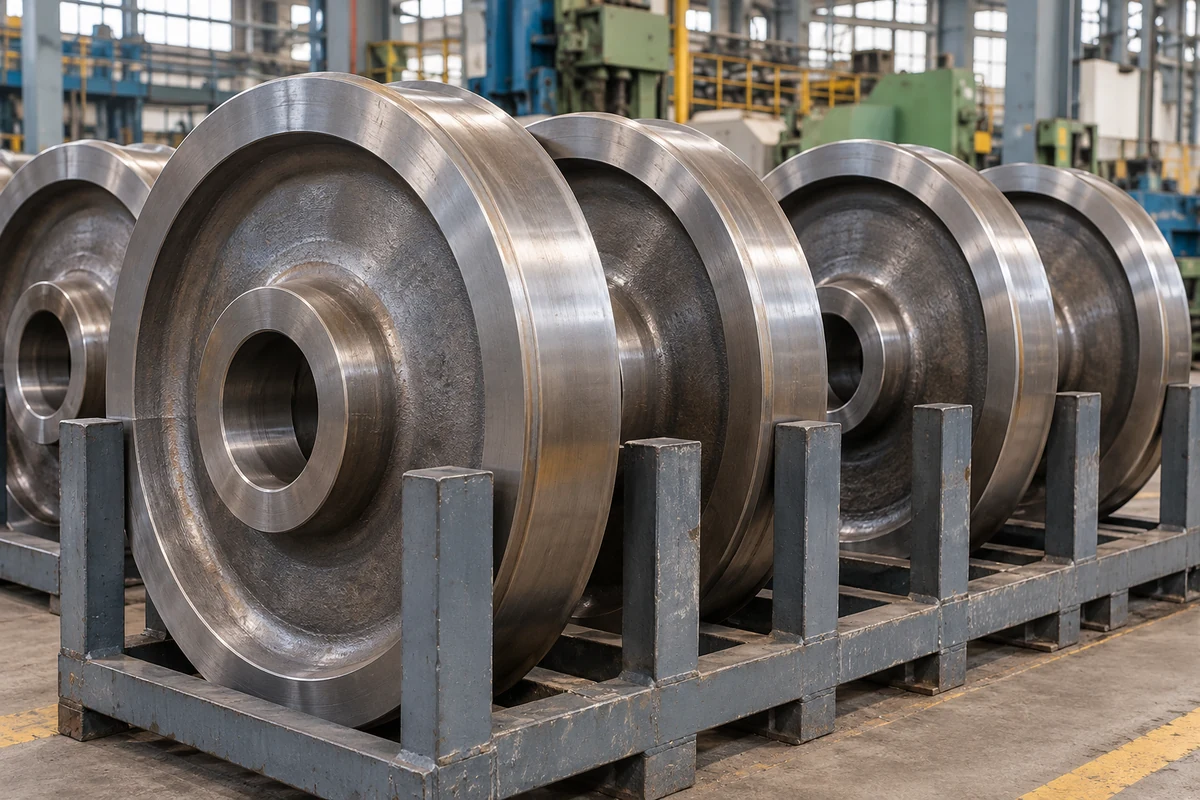
Indian Railways has commissioned a long-term forged-wheel supply programme involving Ramkrishna Forgings and Titagarh Rail Systems. The railway ministry linked the programme to demand from faster trains and to reducing imports. In January 2025, the ministry projected an annual requirement of 200,000 wheels from 2026 onward, against domestic production capacity of 75,000 wheels for 2024–25. It also identified China as the principal source of imported requirements following disruption associated with the Russia–Ukraine war. The proposed new factory is in Tamil Nadu, with the companies locating the project at Chennai.
The railway ministry's January statement put wheel imports from China and Russia or Ukraine at approximately ₹900 crore during 2024–25, while identifying another 40,000 wheels sourced from Steel Authority of India. The ministry also described a history of imports for locomotives and LHB coaching stock stretching back to the 1960s. The supplier countries included the United Kingdom, the Czech Republic, Brazil, Romania, Japan, China, Ukraine and Russia. Its January 2025 update concerned a factory still under construction, with equipment deliveries and commissioning ahead.
The twenty-year contract and delivery schedule
Ramkrishna Forgings and Titagarh announced the award on June 16, 2023. Their agreement covered 1.54 million forged wheels over twenty years, with a stated contract value of ₹12,226.5 crore. The initial delivery schedule called for 40,000 wheels in the first year, 60,000 in the second and 80,000 in each subsequent year. These quantities add up to the announced total: 40,000 plus 60,000 plus eighteen annual deliveries of 80,000 equals 1,540,000 wheels. The annual figures describe the contractual supply programme. The companies separately planned manufacturing capacity above the railway's steady annual offtake, including provision to supply private customers and export markets. The intended applications named in the award included LHB coaches, WAG9 locomotives and Vande Bharat Express trains.
The original investment assumptions were smaller than the later project estimates. In June 2023, the partners targeted total annual production of 200,000 wheels when the factory became fully operational and estimated capital expenditure of ₹1,000–1,200 crore. By the June 2025 project update, Ramkrishna was describing a 228,000-wheel annual plant and a project cost of ₹2,000 crore. Both sets of figures were plans published at their respective dates. The original agreement also expressed the railway's ambition to localise wheel production and meet future demand through domestic private manufacturers. Ramkrishna managing director Naresh Jalan and Titagarh vice-chairman and managing director Umesh Chowdhary presented the award as a long-term manufacturing commitment. Neither statement supplied actual annual output from the future Chennai factory.
The joint venture and the Chennai site
The partners incorporated Ramkrishna Titagarh Rail Wheels Limited on June 9, 2023. Titagarh confirmed the incorporation and the wheel contract in its revised earnings announcement on July 22 that year. In the later corporate structure disclosed by Ramkrishna, the forging company held 51% of the venture and Titagarh held 49%. Ramkrishna was the lead partner in the railway contract. The June 2023 announcement had described equal equity contributions for the initial capital expenditure requirement; the June 2025 ownership disclosure identified the subsequent 51:49 shareholding. The venture's business was manufacturing and supplying forged wheels under the long-term agreement.
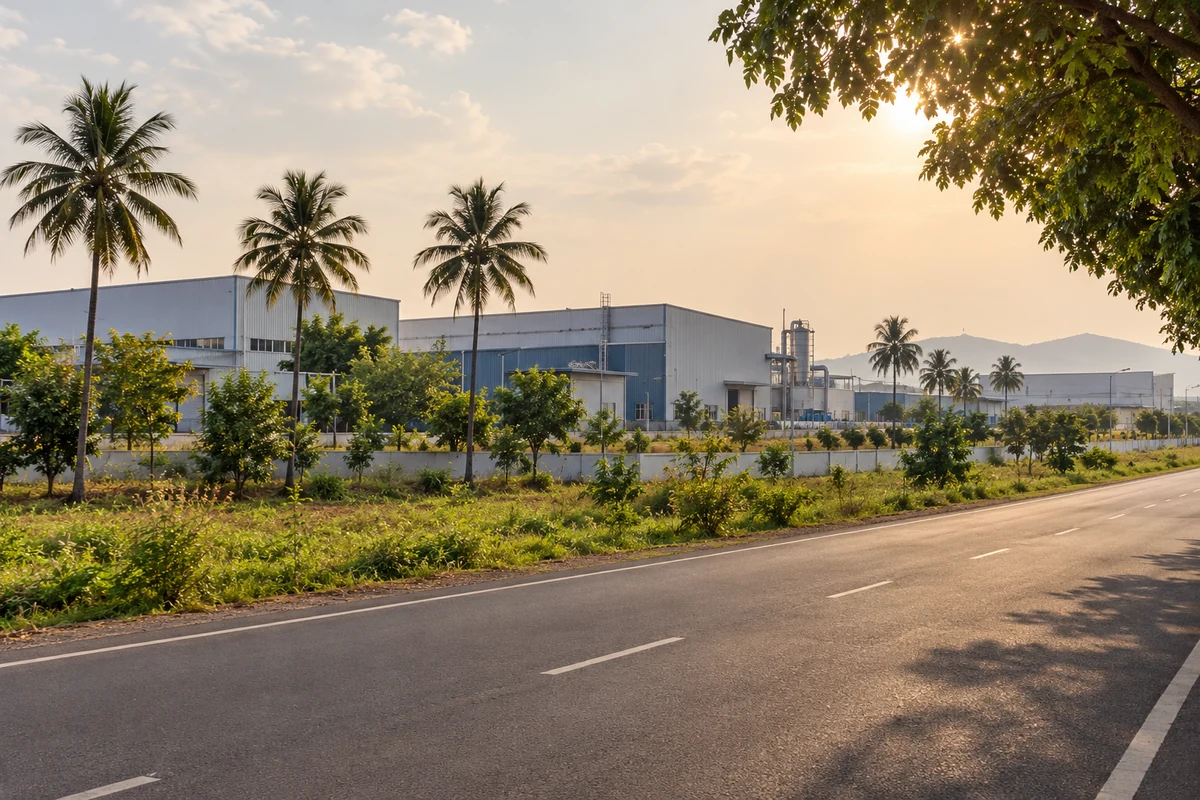
By January 2025, the railway ministry said the venture had acquired 72.75 acres in Tamil Nadu and was carrying out civil work, including construction of factory sheds. Its update placed expected plant completion in March 2026 and equipment dispatches from March 2025. Ramkrishna subsequently confirmed that equipment deliveries had begun in its update for the quarter ended June 30, 2025. Installation then included a rotary-hearth furnace, a railway-wheel forging and rolling line, and a heat-treatment line. Ramkrishna's forecast at that stage was for operations to begin by January 2026. The two announcements therefore carried different projected completion or operating dates. Both described development and installation work, with the later presentation giving a more detailed list of plant equipment.

Automated machining and testing equipment
The railway ministry also outlined the administrative arrangements for executing the contract through a special-purpose vehicle. A Railway Board letter dated September 9, 2024 agreed to that request in principle, subject to a condition concerning the lead consortium member's majority shareholding in the vehicle. In January 2025, the ministry said Ramkrishna's response was awaited. The Railway Board had also issued a letter for twenty wheels to be made available on a paid basis for sample purposes. The project therefore involved a consortium supply agreement, a joint-venture manufacturing company and further exchanges with the Railway Board about the contractual vehicle and wheel samples.
MAG IAS, part of Fair Friend Group, announced its production-line contract on February 11, 2025. The supplier described a turnkey machining and testing system for Chennai, designed for 100,000 railway wheels a year. It said the system could handle six wheel types without a changeover and could be expanded to twice its initial capacity. The announced equipment included MAG SPECHT 800 horizontal machining centres and HESSAPP VDM 1600 vertical lathes. The scope also covered coolant and chip management, measuring machines, a balancing station, ultrasonic testing units and two magnetic-particle inspection stations. Automation was planned for both machining and testing cells. These were the supplier's system specifications; the 100,000-wheel figure concerned that line, while Ramkrishna's 228,000-wheel figure concerned the planned factory.

The SPECHT family comprises horizontal machining centres configured for different workpiece and production requirements. The larger SPECHT 700 and 800 machines use a modular platform with interchangeable combinations of spindles, rotary tables, tool magazines and axis modules. Their beds accommodate wet machining and dry machining with minimum-quantity lubrication. Loading options include manual access at floor level and automatic loading from above or from the front. Workpieces can be loaded directly or through a pallet changer. Standard SPECHT 800 tooling uses the HSK-A100 interface, with long and heavy tools up to 690 millimetres and 30 kilograms identified for the larger-machine range. A rigid cast bed sits on three-point supports, and an integrated spiral conveyor can be arranged at the front or rear. These are MAG's September 2023 catalogue features; Chennai's project announcement specifies the SPECHT 800 model.
Planning, monitoring and supplier responsibilities
FFG prepared a digital twin and three-dimensional simulations for planning and commissioning the system. It also calculated energy consumption for different production scenarios before installation. Central control was intended to monitor the line and track individual components. The announcement scheduled production to begin in the first quarter of 2026, matching the broader period covered by the commissioning forecasts. MAG IAS India managing director Shashank M.P. associated the contract with combining German equipment and local Indian manufacturing. FFG chief executive Sebastian Schöning identified the supplier's turnkey experience and cooperation between its German and Indian teams as factors in winning the order. Both executives were discussing a future production system and their companies' capabilities.

MAG's SPECHT system platform supports several ways of arranging production machines and moving workpieces. Its modular equipment can use overhead gantries with linear lifting axes, robot arms or sequential stations with manual loading. Adapter plates and zero-point clamping systems provide interfaces for workpiece fixtures. Single-spindle machines offer disc or chain tool magazines, including side-mounted and overhead configurations. The catalogue also describes optional tool-breakage monitoring and tool-taper cleaning. These options belong to the broader machine platform available to production-system designers. For Chennai, FFG specified central monitoring, component tracking and automation for the machining and testing cells. The supplier described the equipment order as a double-digit-million-euro project, without disclosing an exact price. Its announced doubling provision would take the line from 100,000 to 200,000 wheels annually if implemented, calculated from the initial design figure.
Ramkrishna's existing manufacturing base
Ramkrishna Forgings was incorporated in 1981. By June 2025, its group described twenty manufacturing units, more than 3,600 permanent employees and customers in eighteen countries. It listed installed forging capacity of 272,400 tonnes a year and casting capacity of 33,600 tonnes a year. Its product range exceeded 2,000 items across automotive and non-automotive markets. The company's manufacturing capabilities included hot, warm and cold forging, aluminium forging, machining, fabrication, ring rolling, gear grinding and casting. Commercial vehicles remained a substantial market alongside railways, mining and earthmoving machinery, farm equipment, industrial components and oil and gas. These group-wide capabilities and tonnage figures belonged to Ramkrishna's established business; the planned wheel factory was presented separately as a joint venture measured in wheels per year.

Ramkrishna already supplied safety-critical undercarriage, bogie and shell components for passenger coaches and locomotives before the wheel venture. Its June 2023 company profile identified closed-die forgings made from carbon steel, alloy steel, micro-alloy steel and stainless steel. Customers could receive parts in forged, heat-treated and machined condition or as fully assembled components. Its manufacturing base at Jamshedpur included forging and die-making, machining and heat-treatment facilities, including isothermal annealing. The company supplied original-equipment manufacturers and tier-one component businesses in domestic and overseas markets. Its automotive customers included Tata Motors, Ashok Leyland, VE Commercial and Daimler in India, as well as international commercial-vehicle manufacturers. These operations formed the established component business alongside which Ramkrishna was developing the new wheel venture.
Titagarh's rolling-stock operations
Titagarh brought an established passenger- and freight-rolling-stock business to the partnership. Its July 2023 company profile identified engineering infrastructure at Uttarpara and Titagarh in West Bengal and at Bharatpur in Rajasthan. Aluminium-bodied Pune Metro coaches were being manufactured at Uttarpara with designs developed in partnership with its Italian venture. The company was also supplying wagons and developing propulsion equipment. Six prototype traction motors had been supplied to Chittaranjan Locomotive Works on December 1, 2022. The locomotive carrying them entered a six-month field trial on December 26 that year. Fitment trials were completed on June 26, 2023, and clearance for bulk supply followed on July 10. Titagarh subsequently placed the remaining motors for inspection before dispatch.

The company's July 2023 order announcements covered several distinct railway products. A Gujarat Metro Rail Corporation acceptance letter concerned seventy-two standard-gauge coaches for the first phase of Surat Metro, worth about ₹857 crore. Private-sector wagon orders in the quarter were valued at approximately ₹443 crore. A separate Titagarh–BHEL consortium had signed a contract involving eighty Vande Bharat trainsets, upgrades to government manufacturing units and a trainset depot. That trainset agreement was valued close to ₹24,000 crore and included maintenance over thirty-five years. The forged-wheel contract belonged to the Ramkrishna–Titagarh consortium. Titagarh therefore participated in different partnerships for trainsets and wheels, with different quantities, contract values and service obligations. Its manufacturing sites also produced finished rolling stock, while the Chennai venture was being built to supply a particular component.
Equity funding and the railway business mix
Titagarh's order book stood at ₹27,890 crore in its July 22, 2023 update. Its two operating segments were freight rolling stock and passenger rolling stock. Umesh Chowdhary associated the company's expected freight-business growth with the Dedicated Freight Corridor and railway infrastructure expansion, while identifying passenger rail systems as another area of activity. The company said capital expenditure for both operating segments and a component facility was progressing. The orders and projects it identified included:

- Forged wheels, through the joint venture with Ramkrishna Forgings.
- Vande Bharat trainsets, through a separate consortium with BHEL.
- Metro coaches for Surat and Pune, alongside freight-wagon orders.
Ramkrishna's June 2025 update put equity infused into the wheel venture at ₹370 crore as of June 30. The planned ₹2,000 crore project was to be financed with both debt and equity. The same quarter's consolidated results for Ramkrishna showed revenue from operations of ₹101,526 lakh, equivalent to ₹1,015.26 crore, with consolidated EBITDA of ₹14,861 lakh and an EBITDA margin of 14.6%. The company reported year-on-year revenue growth of 6%. Jalan attributed the operating environment to export weakness and tariff uncertainty while pointing to new orders across automotive, non-automotive and railway markets. These were the sponsor's group results for the quarter, rather than revenue from a Chennai factory that its project update still described as under installation.
Railways accounted for 4.6% of Ramkrishna's standalone revenue in the year ended March 2025 and 6.2% in the quarter ended June 2025. Ramkrishna also received ₹23 crore of railway orders with a one-year programme life in that quarter. The larger ₹660 crore batch of new orders had a four-year programme life and excluded railways; it comprised ₹502 crore of export business and ₹158 crore of domestic business. The annual and quarterly revenue shares cover different reporting periods, and the order figures describe contracted business rather than completed production. At the Chennai project, the disclosed work remained construction, equipment delivery and installation. The published programme joined the existing twenty-year supply agreement to a planned factory, a defined automated machining package and successive company forecasts for the start of operations.
Leave a comment