
Merida: operating results, investment losses and bicycle production
Merida’s 2024 operating business, investment losses, manufacturing footprint and revenue mix, with the company’s dividend proposal and production plans.
Operating profit and an annual loss
Merida Industry finished 2024 with consolidated revenue of NT$29.63 billion and operating profit of approximately NT$3.03 billion, while recording a consolidated net loss of NT$766.2 million. The bicycle manufacturer’s investment in Specialized Bicycle Company was central to the loss discussed at its March 2025 investor presentation. Merida owns 35% of Specialized. Bicycle Retailer & Industry News reported the results on March 14, 2025, distinguishing the profitable operating business from the investment-related charges. The company’s board also proposed a cash dividend despite the annual loss, citing the condition of its core business and the nature of those charges.
In its March 13, 2025 presentation, Merida assigned NT$9.17 per share to its operating contribution and a negative NT$11.51 per share to other investments, producing the reported loss of NT$2.34 per share. This was the company’s presentation of the earnings bridge. The per-share amounts are distinct from the operating-profit and consolidated-loss totals expressed in millions or billions of New Taiwan dollars. Merida characterised the core business as growing and profitable, while attributing the annual loss principally to recognition of non-operating investment losses.

The later 2024 annual report gives the broader consolidated accounting totals. Non-operating income and expenses together produced a net expense of NT$3.766 billion, compared with NT$636.3 million in 2023. After operating profit, Merida recorded a pre-tax loss of NT$732.7 million and income-tax expense of NT$33.5 million. The resulting NT$766.2 million consolidated loss included NT$699.1 million attributable to owners of the parent and NT$67.1 million attributable to non-controlling interests. These categories explain why the loss attributable to parent shareholders differs from the loss of the consolidated group as a whole.
The investment charges
Merida divided the investment loss discussed in March into two broad components. Operations and other items represented 8%, while the remaining 92% combined a valuation allowance on deferred income-tax assets with goodwill and right-of-use asset impairments connected with retail operations. The company did not disclose separate percentages for the tax-asset allowance and the retail impairments within that larger component. Its description of most of the loss as a one-off accounting charge was a management explanation of the year’s result, rather than a statement that Specialized had no operating loss or that future investment results were assured.

The deferred-tax component concerned an allowance against the value of tax assets. Merida described that adjustment as non-cash and said tax benefits could remain available in future profitable periods, subject to the relevant rules and time limits. That description applies to the valuation allowance; it does not convert the entire investment loss into one identical accounting item. The retail-related component involved goodwill and right-of-use assets. Merida grouped those impairments with the tax allowance in its 92% category, while keeping operations and other items in the separate 8% portion of the presentation.
For the retail impairments, Merida linked the lower valuations to a change in market conditions following pandemic-era bicycle-shop acquisitions. The company said brands had acquired shops to increase market share, after which weaker demand reduced their valuations. It also said Specialized’s inventory and cash position had returned to pre-pandemic levels. These were Merida’s assessments of its investment and the associated retail business. They concerned a different reporting perimeter from Merida’s consolidated inventory, receivables and liabilities, which remained separately disclosed in its own annual financial review.

Group growth and the parent-company perimeter
Merida’s consolidated sales revenue increased by 8.7% in 2024, from NT$27.261 billion to NT$29.633 billion. Group bicycle unit sales rose from approximately 1.167 million to 1.418 million, an increase of 21.53%. The parent-company figures moved differently: unit sales fell from 462,800 to 380,000, while revenue declined from NT$20.009 billion to NT$18.216 billion. Those parent figures sit within the wider consolidated business. Adding parent revenue or unit sales to the group totals would count part of the business twice and obscure the contrast between the two sets of results.
Merida’s own premium-brand business in China increased unit sales by 39.1% and sales value by 50.8% during 2024. The company attributed the increase in consolidated revenue, cost of sales and gross profit primarily to stronger demand in that market. Its Taiwan premium-export business faced continued inventory adjustment in overseas markets, with the annual narrative recording lower volumes and sales value. These different trading conditions accompanied the divergent group and parent-company results. The company’s explanation connects the figures to particular markets, without treating all factories or sales channels as having experienced the same movement.
The March presentation also showed a shift in revenue composition. Taiwan exports represented 50% in 2024, down from 55% in 2023, while the China domestic category increased from 23% to 31.6%. China exports declined from 2% to 0.4%, and subsidiaries accounted for 18%, compared with 20%. These are the company’s reporting categories for revenue sources and channels. They are not a complete allocation of final consumers by country, since an export category identifies an originating business stream and the subsidiary category aggregates a different part of the organisation.

Margins and operating costs
Consolidated gross profit increased from NT$5.114 billion in 2023 to NT$5.380 billion in 2024, while operating costs rose from NT$22.147 billion to NT$24.253 billion. Merida’s presentation rounded the group gross margin to 18% for 2024, compared with 19% for 2023 and 17% for 2022. These percentages describe gross margin. They are separate from the operating-profit figure, the net result after investment-related items and tax, and the earnings-per-share figures used in the March presentation. Each measure therefore retains its own place in the account of the year.
An adjustment for realised or unrealised gains on transactions with investees also affected the operating result. Merida recorded a negative NT$31.6 million adjustment in 2024, compared with a positive NT$509.8 million adjustment in 2023. After that adjustment, the gross-profit subtotal was NT$5.349 billion, down from NT$5.624 billion. Operating expenses increased to NT$2.316 billion from NT$2.238 billion. Consolidated operating profit consequently declined by 10.42%, to NT$3.033 billion from NT$3.386 billion. The core business remained profitable, but its operating-profit total was lower than in the preceding year.
The parent-company income statement had its own operating figures. Revenue of NT$18.216 billion was accompanied by operating profit of NT$1.579 billion, compared with NT$2.002 billion in 2023. Parent non-operating income and expenses produced a net expense of NT$2.508 billion, and the parent’s after-tax loss was NT$699.1 million. The group’s annual net loss was larger because the consolidated accounts included the non-controlling share as well. Keeping the parent and consolidated statements separate avoids using the parent’s operating profit with the group’s revenue or presenting the shareholders’ attributable loss as the entire consolidated result.

Factories, assembly and equipment
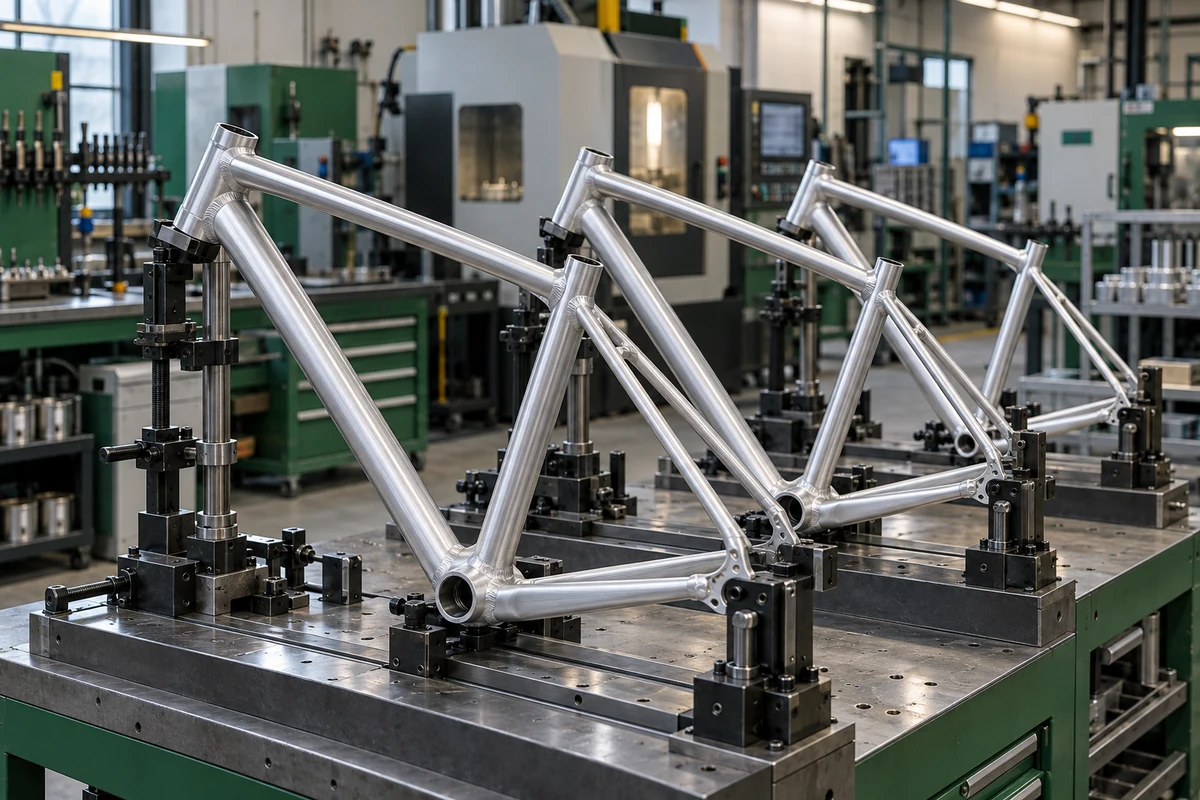
Merida’s manufacturing network includes its export-oriented plant in Taiwan and bicycle manufacturing in Shenzhen, Shandong and Nantong. The company’s annual business review explains that most global export orders were being produced at the Taiwan plant in response to trade barriers affecting products originating in China. The plant integrated conventional bicycle and e-bike production, while some final e-bike module assembly was extended to the plant in Germany. Merida presented this allocation as part of its production and supply-chain arrangements, with location and assembly stages kept distinct from unit-sales totals.
Equipment investment included upgrades to pre-processing, laser-cutting machines and automated welding equipment between 2017 and 2024. Merida associated that programme with frame-production capacity and the accuracy and speed of tube cutting. It had also gradually introduced an automated guided vehicle system from 2018 to improve logistics and handling. These were dated investments in production and internal movement of materials. The annual review separately discussed expected capacity benefits from equipment improvements; those expectations are different from a measured increase in the number of bicycles actually manufactured or sold during 2024.
Environmental infrastructure formed another part of the investment programme. Merida reported approximately NT$24 million of wastewater-treatment upgrades over recent years and NT$50 million invested in a solar photovoltaic system completed in 2024. The company expected the solar installation to generate about 1.3 million kilowatt-hours annually, corresponding to approximately 10% of its yearly electricity consumption. These were expected energy benefits attached to the installation, rather than a disclosed full year of measured generation. The company identified its own funds as the funding source for the material capital-expenditure programme discussed in the annual review.

Products, research and trading relationships
Complete bicycles accounted for 92.88% of the company’s main-product business proportions in 2024, with frames, parts and components representing 7.12%. Merida’s business scope includes manufacturing, assembly and trading of bicycles, electrically assisted bicycles and their components. Its research-and-development contribution for 2024 was NT$71.1 million, while the amount through March 31, 2025 was NT$32.2 million. The first figure covers a full year and the second covers a quarter. They describe spending over different periods and do not establish a year-on-year growth rate without an equivalent prior-quarter comparison.
One coded customer, identified as 0301, accounted for NT$12.443 billion, or 41.99%, of consolidated revenue in 2024. Its share had been 47.73% in 2023. Merida described the counterparty as an investee accounted for using the equity method, but did not disclose its name in that customer table. The code therefore remains a code in this account of the business; the table alone does not identify the customer as Specialized. The concentration figure is distinct from Merida’s 35% ownership interest in Specialized, since one percentage measures a customer’s revenue share and the other measures an equity holding.
On the purchasing side, suppliers coded M001 and M002 accounted for 19.54% and 11.75% of 2024 procurement respectively. Both were classified as non-related parties. Merida’s supply overview lists components including forks, brakes, frames, tyres, motors, batteries, gears, hubs and crank systems sourced from multiple domestic and overseas vendors. The supplier codes do not disclose which component maker occupied either position. The figures describe procurement concentration, while the component list describes the categories needed for assembly. Neither provides a basis for assigning an undisclosed supplier identity or claiming that all components came from a single source.

Assets, liabilities and retained earnings
At the end of 2024, Merida’s consolidated total assets were NT$37.582 billion, compared with NT$38.157 billion a year earlier. Current assets increased to NT$17.750 billion from NT$15.800 billion. The company attributed that increase mainly to accounts receivable and inventory. Funds and investments declined to NT$16.027 billion from NT$18.959 billion, principally because equity-method investments fell. These group-level movements are separate from the March discussion of Specialized’s inventory and cash. An improvement described for the investee cannot be substituted for the year-end movement in Merida’s own consolidated current assets.
Consolidated liabilities increased from NT$16.587 billion to NT$17.300 billion, while total equity declined from NT$21.570 billion to NT$20.282 billion. Current liabilities reached NT$12.677 billion, up from NT$11.017 billion, with the company identifying increases in short-term bank loans, notes payable and accounts payable. Equity attributable to owners of the parent stood at NT$19.295 billion, compared with NT$20.520 billion. These are balance-sheet amounts at year-end. They describe the consolidated financial position and are different from the operating-profit, investment-loss and dividend-per-share measures discussed elsewhere in the company’s explanation of 2024.
Retained earnings decreased from NT$17.538 billion to NT$15.079 billion. In March 2025, Merida proposed a cash dividend of NT$4 per share from retained earnings, expressing confidence in its bicycle business and describing the annual loss as principally investment-related. That was the board’s proposed distribution and stated rationale. The March decision does not itself identify a later payment date or establish that shareholders had already received the cash. The proposal therefore retains its original status, alongside the reported reduction in retained earnings and the distinction between a current-year loss and accumulated earnings.

The company’s dated 2025 plans
Merida’s 2024 annual report, published in June 2025, set out sales plans of 1.18 million bicycles including e-bikes for the consolidated group and 430,000 for the parent company in 2025. Those were planning figures, rather than completed annual sales. The company expected inventory normalisation in European and American markets to support demand and anticipated stronger momentum for Taiwan exports in the second half. It also expected its premium proprietary-brand business in China to remain stable. These expectations retain their 2025 management context rather than being presented as subsequent outcomes.
Production plans centred on scheduling lines against orders, allocating staff and improving order-processing workflows. Merida targeted an order-fulfilment rate above 95% while strengthening cost and expense controls. Its marketing plans covered new products, brand services, delivery performance, customer payments and distribution channels. These were operational objectives for the coming business year, with their completion dependent on later activity. The company also planned to manage and expand sources of important e-bike components and adjust production allocation to market requirements, maintaining separate roles for manufacturing sites, assembly operations and the wider sales network.
The international network included 13 companies in Europe, 16 branch offices serving the China domestic market and professional agents in more than 58 countries, as described in the annual review. Those counts refer to companies, offices and agents, rather than an equivalent number of factories. Merida’s reported 2024 sales, the March explanation of investment charges and the later annual production plans cover different aspects of that network. Each retains its reporting period and scope: completed sales and financial results for 2024, a March dividend proposal, and company expectations for the following production and sales year.
Reporting measures kept separate
- Consolidated revenue and unit sales include the wider group; parent-company figures cover a narrower perimeter.
- Operating profit precedes non-operating investment items and tax.
- Manufacturing-capacity expectations and 2025 sales plans are distinct from actual 2024 unit sales.
- The customer’s revenue share, the Specialized equity interest and the proposed dividend per share measure different relationships.
Leave a comment